29.11.07

Worn out fingers to void fingerprints

Don't take it personal but I don't like what Mark Schreiber wrote over the Japan Times about his initiation at getting fingerprinted and photographed at Narita. I don't like the style, the aloofness. He is on the business class side of that issue which is OK as far as opinions are but opinions - gaijin talento are on first class but with the same practical concern: getting the hell out of that airport as fast as possible. And what the heck with "this supposed indignity" as he writes, that human rights thing so passé - and the hopeless boast at delivering his essay as "the most exhibitionistic manner possible: the article you are now reading" in the Japan Times. And a media where thanks god, you cannot as easily hear feedback from your dear readers. Another reason for me not to support that newspaper (but then what are we left with? The Yomiuri?).

Anyway, there are a few concerns with what is exposed in that article. One is that the authorities would try and fingerprint whatever finger can be scanned, maybe, as that author's worn out index prints made the scanners call it quit. Mr. Schreiber asks "Why wasn’t I dragged off into a separate room and interrogated? Why, after all the fuss, was I simply admitted on the strength of my passport, status of residence and re-entry permit?" It would be more interesting to know what happens with those reported elderly people entering as non-residents - suspicious old men and women with aged out fingerprints that beat the machine.

Mr. Schreiber also reports that "On a separate note, there’s been much talk about a system that permits residents to pre-register their biometric data prior to departure, either at the main Immigration office in Shinagawa or in the departure areas at Narita.

I hate to be the bearer of bad news, but I can’t see any point to this, either in terms of time savings or exemption from the big, bad biometric bogeyman. Pre-registration or not, unless you’re a Japanese national or a “special permanent resident” (and if you have to ask what that is, you’re almost certainly not one), you will still be obliged to give your fingerprints every time you enter the country.
"

Clarification here again is needed as the story has been so far that pre-registered Japanese as well as residents would be allowed when coming back to zoom through the automated gates.

The rest of the article falls down into terminal college pun deliquescence that pulls the plug out of good journalism.

We need testimonies from entrants and re-entrants not on the Japan Times payroll. We need food for thought, not for cocktails fun anecdotes. Bring your wares and experiences here at Re-Entry Japan.

28.11.07

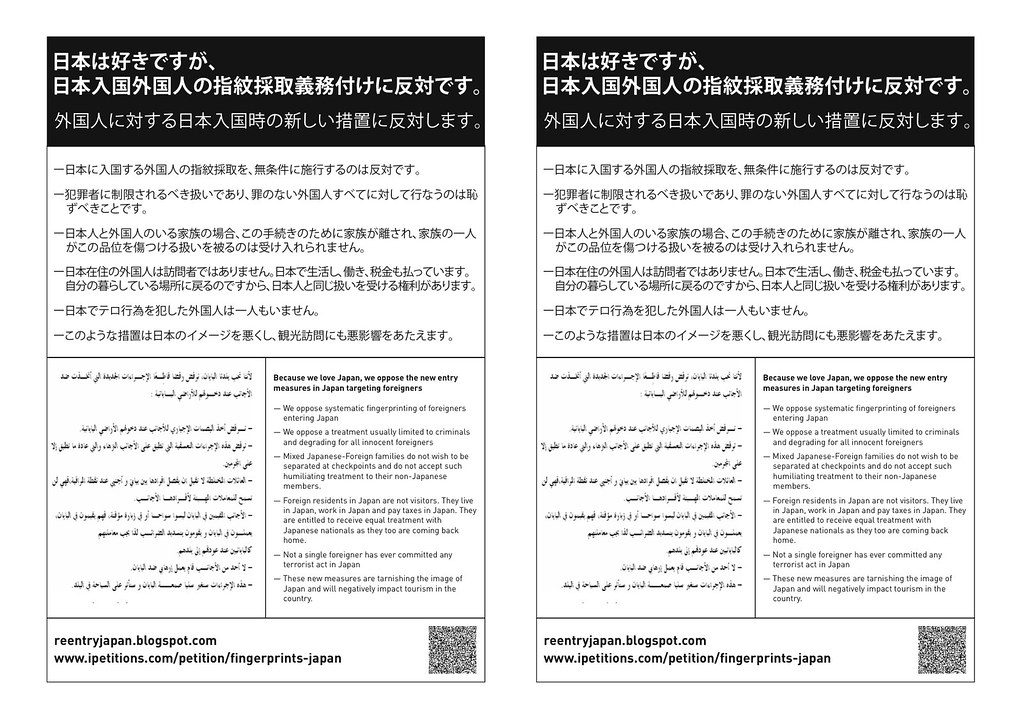
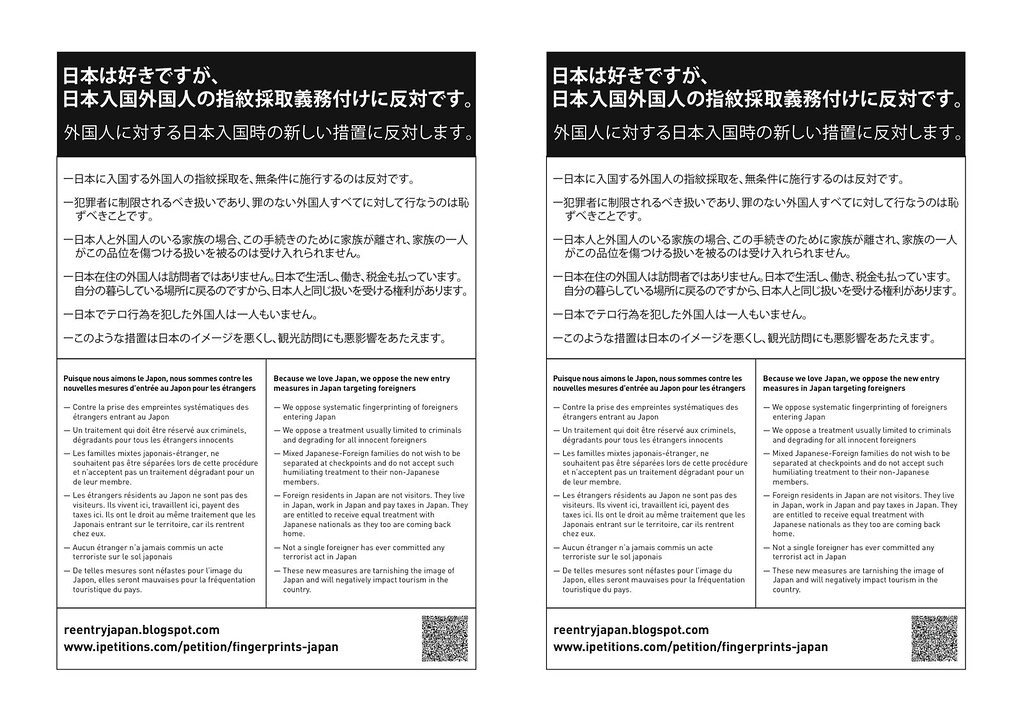
Protest sheet update v1.1

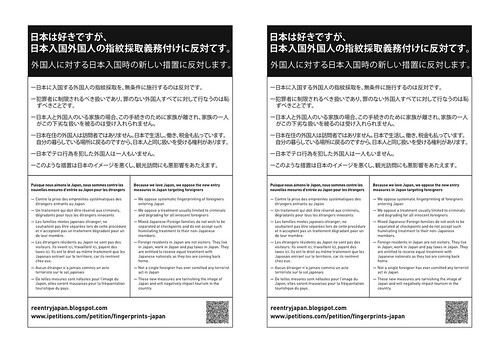
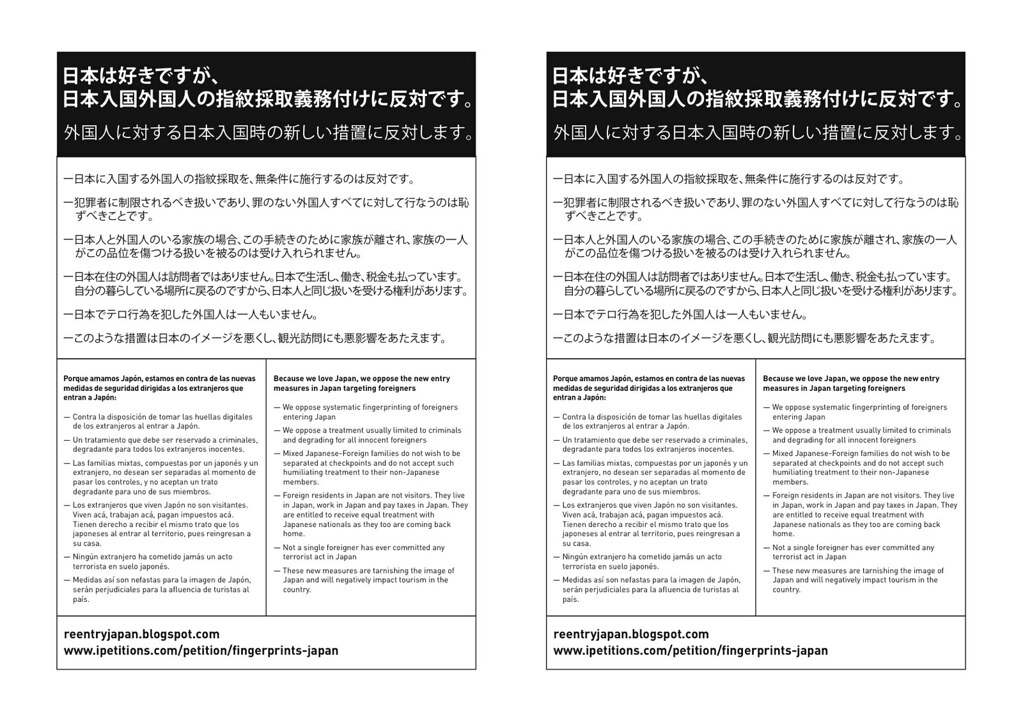
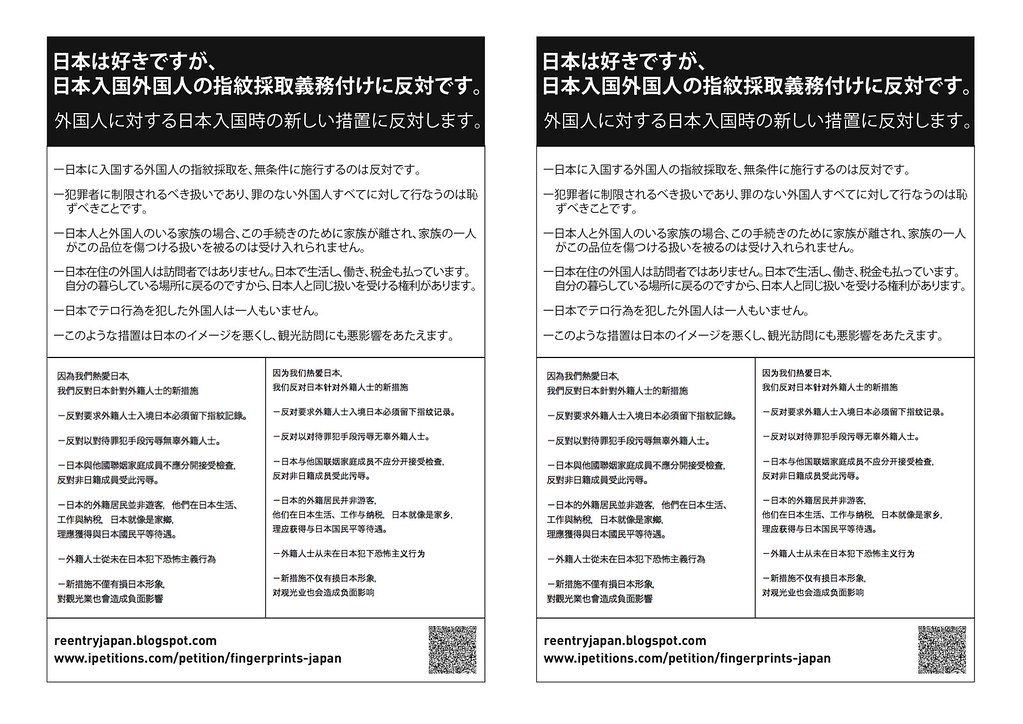
Tract1.1 Protest sheet against fingerprints policy in Japan
Thanks to readers' feedback, the update is available, with a grain of love inside and even a mobile access ! Scan the QR code with your cell phone and spread the word to your friends via mobile email.

Caution: the usage of the tract is yours but please to be responsible. No littering, no public distribution - prior authorization is required. We suggest to behave in clean and matured manners and avoid confrontation. A key purpose of this tract is to raise awareness to Japanese people.

Links to download latest versions are located on the upper right column of this screen.

Let's RFID tag foreigners

Brave new world. There are mornings you want to be saved reading the news, saved reading and watching the villain, the vilified politician of the month, former Vice Defense Minister Moriyami brought to prison, saved reading about Miyazaki prefecture's governor Hideo Higashikokubaru musing aloud in a public meeting about the needs to a one to two years military service (re)instated in Japan. Or what about this one: "A group of Japanese cities with communities of non-Japanese residents called on the central government in a conference Wednesday to establish a national registry to help improve keeping track of foreign residents who move localities." Municipalities are loosing track of some foreigners who do not log in at the local authorities when moving towns. What the local registries have been incompetent at dealing with, a national registry will. Of course, these utterances are spilled most probably in good faith for the good of the community at large. But what about the grounding thinking that support those concerns? What about the collaterals? Why not jump a step further ahead right away and call for the RFID tagging of foreigners, including visitors at the gate? No more fingerprinting. A shot in the arm and welcome to Japan. Implant chips to identify the livings. Track them on GPS, radar screens swarming with blinking dots. Call Hollywood, I have story.

27.11.07

With a grain of Love inside

The nice thing about asking for people's input is when people provide great inputs. Think about the original tract as version 1.0. Version 1.1 is coming soon, taking a grain of Love inside.

26.11.07

The Tract, and how to use it

Reentry Japan Protest
Here is a tract you may consider using to express your disagreement at large, be it the whole biometric filing of foreigners only or the discrimination toward foreign residents of Japan. The interpretation is yours as the method. This was already discussed in a previous post but here are possible ways to use it.

• Pass a copy together with your passport at the gate. The staff will probably give it back to you and it's OK. There are still ways to reuse it before leaving the port of entry.
• When coming back in family discuss together before arrival and decide on the opportunity that each member slip a copy with his/her own passport.
• Print several copies before boarding the plane or ship back to Japan and neatly put a stack of copies at the counters before after passport control where Japanese nationals may stop to fill import tax or other paper.
• Before leaving the airport, visit the washrooms and neatly paste a copy inside the door using easy to scrap tape. Making things cleanly is important.
• If you leave the airport by limousine bus or train, why not stash a copy inside the onboard magazine.

How you can help:

  • Be creative: come with your own suggestions on how to spread the tract efficiently
  • Make suggestions on how to make the tract content better. Also suggest alternative versions
  • Write a short testimonial about your entering or coming back home in Japan using the tract
  • Take a picture of the tract set in the airport and send it to the blog with a comment or article
  • Refer to this post in your blog, or write a post in your blog and make the tract available yourself
  • Download the file and send it attached to friends and family, asking them to pass it along as well
You can download the document here.

Fourth generation Chinese resident testimonial

There is an interesting testimonial over citizen media blog JanJan from a fourth generation Chinese national in Japan about having gone through all fingerprnting "technologies" introduced and scrapped over the years in this country.

The last sentences are especially interesting in telling the state of mind and possibly standard attitude of Asian people living in Japan over many generations.

在日華僑4世として、100年以上も日本在留を続けている我が家の「家訓」の一つに「いかなる悪法といえども、法は法。長期にこの国で安定的に暮らしてゆくためには遵守しなくてはならない」というのがある。

 しかし「不愉快」であることを表明することは自由である。ただその「表明」する方法に「工夫」は必要である。私は親しい日本人に自分の「心情」を「折に触れて話す」ことにしている。
As a family of fourth generation Chinese living in Japan over more than 100 years, we have that precept that says : "Even bad laws are the law. In order to pursuing a stable life for the long term in this country, we must comply."

The Chinese person concludes referring to a previous statement in the article of sour feeling with the new biometrics filing: "But voicing ones "sour feeling" is free. However, the "process" to express this view must be adapted. I make a point to touch base and tell my true feelings to Japanese friends."

25.11.07

The keys to annoying the authorities

Over there at the Sankei newspaper on MSN is a piece of common civic journalism giving away - in its dull banality - the keys to what annoys the authorities with that biometric process. The title alone tells it all: 入国審査厳格化 成功のカギは理解と協力. The key to success with the reinforced immigration control is (to gain) understanding and cooperation. Cooperation may loosely refers to "submit the fingers and the face" without a wink. What to do with this is open to self-judgement, but social and family concerns justify not to refuse and bear the consequence. But understanding, they won't get, and that is at the very core of Re-Entry Japan. Debating, discussing, writing, sharing about the discontent are all actions for the purpose of rehashing again and again that understanding, there won't be any. What's the use of a blog if no action against is taken? This will be a standard argument to dismiss the purpose here. It doesn't work. Although tiny, Re-Enter Japan is a form of "gai-atsu" from within, that is "foreign pressure" that itches. Keeping up with the itching and trying and gain some better understanding of issues at large is the goal. What's lying ahead is increased reciprocal understanding and less conflicts. Not a bad thing to gain.

It's not illegal and other simpleton arguments

Some people are signing under the comfortable and falsely safe "Anonymous" identity to comment against the very purpose of the petition. They are deleted of course, not for the sake of censorship, but for obvious reasons. One latest such simpleton comment reads like this:

"Its not illegal...The United States are doing it to people who enter too!!..no big deal!!..your going to lose this cause"

I make a point not to simply trash these things but give some time to munch on that standardized fast food brainless pattern of thinking. We have the usual arguments well wrapped up in a single package:

- It's not illegal ---> who is questioning legality here?
- The US are doing the same ---> doing the same elsewhere as a green light to do the same at home
- No big deal ---> they don't charge for extra luggage at the counter with one's dignity, sure.
- You will loose ---> a lost cause? exercising the right to challenge the validity of a rule is not lost on the freedom to say : "I do not agree". That is, until they take that freedom away.

Wanna new fingerprints ?

Tsutomu Matsumoto is a Japanese mathematician, a cryptographer who works on security, and he decided to see if he could fool the machines which identify you by your fingerprint. This home science project costs about £20. Take a finger and make a cast with the moulding plastic sold in hobby shops. Then pour some liquid gelatin (ordinary food gelatin) into that mould and let it harden. Stick this over your finger pad: it fools fingerprint detectors about 80% of the time. The joy is, once you’ve fooled the machine, your fake fingerprint is made of the same stuff as fruit pastilles, so you can simply eat the evidence.

Read more here:
Make your own ID
Ben Goldacre
The Guardian
Saturday November 24 2007

Protester dans le plâtre


via

A cup of fear a day keeps the anzen-boke away

I learned a word this morning watching their masters' voice NHK clip showing minister of Justice Hatoyama delivering a speech to call for support of the biometrics rules. As is the standard style with reports of speeches here, most of what Hatoyama says is kept muted while the NHK announcer delivers the mantra. The notes on the clip page and the subtitles on the clip screen somewhat help fill up the blanks. Referring to his friend of who has a not recommendable friend that would make all the buzzers and bells shriek at Narita, Hatoyama is reported to have said that "世界一治安のいい国を目指すには、ある程度、真実を話した方がいいと思った。", or, In order to aim at being the safest country in the world, I thought it better to tell the truth to some extend ...". The subtitles do not display the expression "to some extend", and may closer reflect what Hatoyama says, but viewers are not allowed to listen anyway. Linguists as psychiatrists could spend the day and more pondering about how the world differs "to some extend", whether to tell the truth or just part of it, or just make up a story to enlighten the mass and have them drink a cup of fear and feel safer (the placebo effect). It is just like suddenly pouring freezing water on somebody's head and come at the same time with a warmed towel to clean up the mess and have the prank victim feel soothed by the people above who threw the bucket. Indeed, the prescription is to avoid Japanese to fall under that dangerous sense of "security senility" or "anzen-boke", the word I now know and feel better with this knowledge.

Fingerprints and yogurt

It is a slippery random thinking exercise to try and put Japanese biometrics of foreigners in a cultural context, and pretend hard the filtration of foreigners by Japanese authorities is cultural, whereas filtration happening in other countries' borders is "simply tactical". Biometrics filling serves some common purposes with a degree that are:

- cross-checking with a database of terrorists, suspects and wrongly filled individuals
- gathering traceable ID factors to potentially trace back criminal acts to their potential perpetrators
- exclude individuals having previously entered the country on falsificated passports
- analyze at a more grainy detailed level the "quality" of foreigners inflows by characteristics of races on top of nationality (any skin color detector software in the back-office?)
- monitor in a deeper way the movements of foreign residents
- allow for various drill-down analysis pertaining to the management of "the good immigration" policies to come

Whether there is a intent in the following is open to conjectures, but there are consequences at large when tracing people not in terms of residency, but in terms of nationality. Collateral consequences of biometrics filling are:

- reinforcing the "malaise" toward foreigners, and especially toward foreigners who "look different". Interestingly, the stigmatizing reinforces suspicion if not hatred of those "national others" living next door.
- reinforcing the we versus they that is at the core of tribal conflicts worldwide
- reinforcing the idea that sustaining fear of possible disasters is the grown-up way to build confidence in peace and security, in others word, teaching kids the unmanageable request to be both fearful of the future and build a bright future parents even do not believe in (and it shows in daily life)
- nurture the kids ever further through silent, implicit education and hints that the gap to others is fixed

The list could go on and on and would need strict review and editing.

On a lighter, ironical side, the pack of yogurt we have at home currently is the Megumi brand made by the Megmill Corp. in Japan, of notorious past under a different name. It is a national yogurt, as much proudly produced here in Japan as any product "proudly made in ------- " insert the name of the country you like. The use of nationalistic propaganda as key elements of catch-phrases in advertisement is not new. But it feels certainly more prominent these recent years, at least from the perspective of a watcher of such ads in the Tokyo subway (that nostalgic ad of a "castella" cake that "fits the mouth of Japanese people" in the 80s!). Nothing statistically coherent here of course. The Megumi yogurt in one sentence printed on the cap is made with a "Japanese born bacillus to produce Our yogurt". It fits the 1.3 longer length of we-Japanese intestines, as compared with Westerners' innards (other continents have just guts). And despite the fact that bodies tend to grow bigger on average as the story develops, Japanese bellies keep the same (over generation and despite physical traits changes). All this rethorics is to be found on the product web site. Fingerprints are bound to reinforce that kind of message, whatever the color of the yogurt is.

24.11.07

Mainichi.jp: Editorial: Gov't must think hard about fingerprinting foreigners

Editorial: Gov't must think hard about fingerprinting foreigners

Japan has started a new system obligating foreigners entering the country to provide their fingerprints and face photos. The United States started a similar process following the Sept. 11 terrorist attacks and the government has gone along with this, revising the immigration law to make it obligatory for foreigners to take these steps.

Data collected from foreigners entering the country will be matched with that assembled on about 18,000 fugitives on Interpol and Japanese law enforcers' lists, as well another roughly 800,000 who have previously been deported from Japan with the aim of preventing entry into the country for those who match the data.

The Justice Ministry insists that the measures are an anti-terrorism step and Justice Minister Kunio Hatoyama created controversy with his statements about an associate in Al-Qaeda, and there are doubts about how effective this process will be. The system still makes it very difficult to capture terrorists who have no prior convictions and it is not possible to say that the government can adequately cover every port of entry, especially when it comes to those entering by sea and particularly those smuggled in.

Where the system will show its teeth is combating those entering illegally using false passports. Of the roughly 56,000 people deported from Japan last year, about 7,300 had been expelled from the country at least once before, including some foreigners who should never have been allowed into the country in the first place, and immigration authorities were widely criticized for their lax control. Immigration and law enforcers also had to suffer a backlash after it was learned that fugitive members of the Japanese Red Army had been sneaking in and out of Japan using false passports. But the new system should make it impossible for repeated re-entry into the country using false passports. The new system should also prove effective in countering the crime gangs who leave the country following raids, come back in again once things have calmed down and then flee once more.

Surrounded by water on all sides, immigration authorities obviously saw implementation of the current system as a task of great importance, but there are many things that need to be taken into account when considering this first attempt at halting crime by foreigners coming to Japan. To ease the problems associated with taking people's fingerprints and keep the system in process, naturally clear explanations of the system are necessary and it goes without saying that steps must be taken to make sure the data collection process is spread up so that it does not become a burden on those foreigners entering the country.

The ministry must also clearly state the standards by which collected data will be preserved and handled. Going by what the ministry has said so far, the data collected will not be necessary if the person who presented it is not on any of the lists used for comparing it with. Even considering keeping the fingerprints and photos on file in case of trouble while the presenter is in the country, this data should be destroyed when the person leaves the country, or at least after a set period of time. There should be a set limit for how long this data can be kept. Considering that there have been many criticisms of faults in the U.S. system, the government must, on the basis of controlling individuals' private information, set clear steps of the processes involved in dealing with what happens when somebody's details match those on the lists and what happens when somebody is mistakenly added to those lists. It is also essential that punishments be put in place for any misuse of the information obtained.

The ministry must also outline its long-term vision of how it plans to improve the working conditions of foreign laborers in Japan and unskilled foreign workers in the country. Japan has been widely criticized for the abuse and poor payment that foreign trainees coming to this country have received here and it is a fact that many of the foreign laborers here without visas are widely appreciated. When tightening immigration controls, the government must also make sure that this does not lead to unfair discrimination and also protects the rights of foreign laborers coming to work here.

If the government is not going to place importance on the situation of foreigners coming to Japan or international opinion in favor of coming up with measures to fight crime, it is not going to receive widespread support for its new system.

(Mainichi Japan) November 24, 2007

Mainichi special: Fingerprinting fury

毎日新聞: 社説:新しい入国審査 安心できる仕組みが欲しい

毎日新聞: 社説:新しい入国審査 安心できる仕組みが欲しい

全国の空港と港で、来日する外国人から指紋と顔写真の提供を義務付ける新しい入国審査が始まった。01年の同時多発テロを受け、米国が同様の対策を講じたことに呼応し、出入国管理・難民認定法を改正して来日外国人に手続きを義務づけたものだ。

 採録したデータを、国際刑事警察機構と日本の警察が指名手配した約1万8000人、過去に日本から強制退去させた約80万人のリストと照合し、該当者の入国を防ぐことを主な狙いとしている。法務省はテロ対策を強調しており、鳩山邦夫法相が不用意な「アルカイダ発言」で物議を醸した経緯もあるが、実効性には疑問もある。前科前歴がないテロリストを発見するのは難しく、港での船員らのチェックや密出入国の水際での警備も万全とは言えないためだ。

 しかし、偽変造パスポートを使う不法入国に、威力を発揮することは間違いない。昨年中に強制送還した約5万6000人のうち約7300人は以前にも送還され、本来は入国が認められない外国人だったとの事実もあり、出入国管理は尻抜けとの批判が絶えなかった。指名手配中の赤軍派メンバーが堂々と密出入国を繰り返していたことが判明して捜査当局をあわてさせたこともあったが、今後は偽名での入国を見逃さずに済む。犯行後、出国し、ほとぼりが冷めると再来日して犯行に及ぶ窃盗団などの対策としても効果的だ。

 四方を海に囲まれ、出入国管理の強化が急務とされながら、今回が初めての来日外国人の犯罪対策であることにも注意したい。指紋採取などへの抵抗感を和らげ、制度を定着させるには、達意の説明が必要であることはもちろん、手続きのスピードアップなどによって来日外国人の負担を軽減させるべきも言うまでもない。

 採録したデータの保存や取り扱い方法についての基準を示す必要もある。従来の説明に従えば、データは一義的には照合が終われば不要になるはずだ。滞日中のトラブル発生時の身元識別の必要を考慮しても、帰国から一定期間後には廃棄すべきであり、保存期間の設定は必要不可欠ではないか。米国でも登録されたリストの不備が指摘されていることに照らせば、本人の個人情報コントロール権に基づき、リストへの登載の有無の照会や誤登載の際の削除要請などに応じる手続きを定めておくべきでもある。情報が悪用された場合の罰則規定も欠かせない。

 来日外国人労働者の労働条件を改善し、単純労働者の受け入れ問題についても長期的な視野からビジョンを示す必要もある。研修生制度によって来日した外国人を低賃金で酷使して国内外から批判を浴びたり、不法滞在の外国人の労働を黙認して重宝がっているのが実情だ。入国審査を厳正にする以上、不当な就労差別などが生じないように、来日外国人労働者の権利の確立を目指さねばならない。

 来日外国人の立場や国際的な信用を重視することなく、犯罪者対策に偏重していたのでは、新制度は幅広い支持を得られない。

毎日新聞 2007年11月24日 0時14分

恥と無知

           恥と無知


 東京(中日)新聞に抗議のメールを送ったのは、我が国を外国のテロリストが自由に横行していることから生じる恐怖を理由に、生体学的情報のデータが必要であると言おうとした法務大臣(鳩山兄弟の弟)の馬鹿げた言明の時でした。この大臣は東京(帝国)大学法学部卒業生の、明瞭さを欠く頭脳とはどんなものかよく現しています。新聞社からはなんの反応もありませんでした。我が国のメディア、また自称インテリ達は、自分は悪くないふりをしながら、外国人の本当の考え、感じ方に無知なのです。彼らの(外国人)理解にたいする能力の欠如には罪深いものがあります。

 こうした措置で我が国の安全が確保される、と胸をはる政府の姿は悲しい。これはアメリカの政策の真似であり、このアメリカの措置は三年以上まえから施行されながら、意味ある、いかなる成果もあげていないようなのです。この施策で喜ぶのは、日本の税関が大量に必要とする電子製品の製造業者でしかありません。ひたすら外国人の迷惑になることだけが目的であるようなこの製品の購入価格は
35 億円(約 2200 万ユーロ)。我が国の外交においてしばしば繰り返されるこの奴隷的模倣は恥ずかしい。

この措置が施行された日(
1120)、私は研究室の副手にメールを送り、同僚の大部分が外国研究に従事している私の学部で、もしだれか、この措置に抗議しようと考えている人がいたら、私もそれに加わるから私に言って欲しいと伝えました。彼女の返事は、「いまのところ、そういう話はないようです。いま風邪がはやっているようですから、気をつけて下さい」というものでした。

南太平洋でのフランスの核実験の時、我々は立派な抗議文を発表し、共和国大統領に手紙を書きました。現在は、風邪の時ではなく、怠惰な忘却の時代であり、恥ずべき後退の時代、無責任感、無頓着の時代です。日本人の品位は本当に落ちていると思わずにはいられません。


 我が国にはよい言葉があります。まれに訪れる人、という意味のマレビト、つまり他国からの客、古代ギリシャ語のクセノスです。マレビトは行く所、常に歓待される権利がありました。遠方からの人間は、ホメーロスの時代のように、常に歓迎されねばなりませんでした。(我々の所からリモージュに送り出している留学生は昔同様、歓待されている)。去る人には贈り物(
tà xénia)が送られました。オデュッセウスは沢山の贈り物をもらって帰郷しています。この種の歓待は日本でもつい最近まで行われていたのです。明治学院出身の作家、島崎藤村の『夜明け前』を読んでみたらどうでしょうか。

 これは江戸時代末期から明治初期(
1850 - 1875) にかけての、あるひなびた田舎の物語です。北の私の田舎(秋田)の住民は、藤村によって上手に描かれた、この昔の日本の中心部の人々と少し似た所があります。彼らはいま展開されている急がしく気違いじみた変化にうまく適応できないのです。彼らには自然な自閉傾向がありますが、それを利用しているのが中央の政治エリートたちです。この後者には、明治初期の激動の時代の反応とおなじ、ある種の外国嫌いのところがあり、西洋人とくにアメリカ人に、侮辱され、バカにされたという奇妙な感覚をもっています。日本人には国際関係といったらまずアメリカとの関係を頭に浮かべますが、アメリカにたいする愛憎がないまぜのコンプレックスはそこから生じるのです。我が国の政府は、アメリカの気に入ることをひたすら急ぐあげく、国家安全保証のもっとも優れた担保が他者をもてなすこと(hê xenia) であることを忘れているようです。


            明治学院大学 文学部 フランス文学科 工藤 進

23.11.07

Love supreme

"I love Japan, but think it treats foreigners horribly. I love living in Japan, it's unjust that I would have to be fingerprinted in addition to the indignity of my profession treating me as a second class citizen, and my neighbors often discriminating against me."

I quote this above from the growing number of comments piling up in
the online petition. We want more signatures. Please, do not simply sign, also tell other people, friends, family, etc. Don't keep it confidential, pass it around, the link, the intention. We also wish for ever more comments, especially more Japanese voices, more foreign voices from people from anywhere under the sun living here, or moving to and from here. A common argument of some jealous foreigners, usually grown-up teenagers blindly enamored with Japan, freshly arrived or dreaming to escape to Mangaland on Zen as one can read on passionate blogs and discussion forums, is that these people, we, I, are representative but of a tiny proportion of foreigners, of those foreigners living in Japan. This is true. Westerners almost do not show on statistical graphs, dwarfed by residents from China, Brazil, and various Asian countries. Any contributor in Chinese language? Any analysis from a Brazilian voice? The reach of Re-Entry Japan might be constrained by the languages we use for sure, and, but this just an assumption, a potential cultural tendency for advocacy at large to be easily found in the West? But does the fact that Westerners are tiny in numbers makes for any reason to simply just shut up? Because what the purest of pure Japan-lovers of the mind are implying is that voicing ones opinion - negative toward the biometrics - is outrageous, and that a true lover must massively love. Love must be supreme.
All this circumvolution to come back to the quote at the beginning of this post. In such short sentence, it is fabulous to read so many strong, disproportionate words: horribly, love, unjust, indignity, second class citizen, discriminating. The reader might be surprised to see "love" in the list. I was not thinking to add it at first but in double thinking, I came to the feeling that this "love" is nothing casual. I don't know what this person is referring to as "the indignity of my profession". I prefer not to muse on tracks that could be totally wrong. And whatever the profession is, it is not my business. But so much love and anger contained in such a short sentence sustains the fact that love is supreme, whatever the treatment received. It can be rightly argued that the charge of onirism and such passionate declaration is first of all self-reflected. But that is what love is all about first, that is feeling in love with being there, now. We are in a typical case of crisis, a massive attack of emotions. Japan in the contemporary mind - propelled by the Net steroids - has been for the past and stronger ever this current decade the Land Of Onirism. It has to be forgiven that when under such strong emotional state, the patient can't hardly behave in sober manner. But the key statement here, and whatever contemptuous smiles it may generate, whatever doubt one might feel - including me - is that small piece of passion: "I love living in Japan". You won't recruit your next suicide bomber from such passionate individual. The bombers of past and future, infiltrated in the countries they target, are passionate haters of that location they have on the radar screen of death.
For all the redundancy of the hundreds of comments to browse in the online petition - and I recommend browsing these - the reader should always keep in mind that from the short burst, the awkwardly written single sentence, to the long and consistent statement, each one is a piece of someone, often living in Japan or having some affairs with Japan where love, even if not supreme, is part of an individual and intimate landscape.

Japanese voices : a contribution from Professor Susumu Kudo

I sent a protest email to the daily Chunichi Shimbun, when our Minister of Justice (Hatoyama the cadet) uttered that idiotic statement, stressing the need of this biometrics filing, on the imaginary and fear-mongering ground generated by free-riding foreign terrorists in Japan! This minister is a perfect example of those bankrupt brains to be found among the old boys graduated from the Faculty of Laws at the (imperial) university of Tokyo. The newspaper failed to send me an answer. Japanese media as well as self-styled intellectuals simulates innocence while ignoring the real thoughts and feelings of foreigners. Their incompetence to understand things is almost criminal. It is a pity to witness our government boasting that in so doing, the national security will be protected. The truth is that this measure is nothing but a copy of what the USA has been doing for more than three years, a measure that has allegedly demonstrated no significant result at all. The only ones to rejoice are the electronic devices makers the immigration authorities must massively use the appliances from. The cost of those humiliating apparatus which unique usage is to disturb foreigners is said to reach 3.5 billion yens. This slavish mimicry, so many times iterated with our foreign policy is indeed a SHAME.

The day when the measure was implemented (November 20th), I inquired by mail to our secretary, asking whether any of my colleagues at the faculty most of whom are involved with foreign studies ha taken the initiative to protest the measure, in which case I would have had added my voice to. Her answer was: at this time nobody is commenting. Please do take care with the current flu!
When France was testing nuclear bobs in the Pacific ocean, we published a grand protesting statement addressed to the French President! Today, it is not the flu that is at stake, but the lazy default of memory, the shameful retreat, the not bright, irresponsible nonchalance. I can help but feel that Japanese people are truly on a degrading slope. There used to be a good expression in Japanese : mare-bito, that is mare (naru) hito, or “who that but seldom appears”. or in other words, the foreign guest, xenos in ancient Greek. Marebito used to always have the right to be welcome wherever they would appear. People coming from far away should always be well treated just like the time of Homer. (Our faculty students in Limoges (France) are very welcome as in the past). People would give presents (xenia) to the living foreigner. Ulysses went home loaded with presents. This kind of hospitality was also offered in Japan until recently. I suggest you read the novel "Yoakeame” (Before Dawn) by writer Shimazaki Tôson, a former student at the university of Meijigakuin.
The story is set deep doen in a Japanese province at the end of the Edo period and the beginning of the Meiji era (1850 - 1875). People of my own Northern regions (Akita) resemble to some extend to the people of central Japan in the past, whom Shimazaki described so well. They have a hard time adapting to fast paced crazy changes that are occurring right now. They display a natural tendency to retreat. Political elites in central Japan are exploiting this tendency. These contemporary elites tend to be rather xenophobic, an heritage from the upheavals at the beginning of the Meiji era. They strangely feel outraged, snubbed by Westerners, especially by Americans. That is where that ambivalent love/hate toward the USA stems from, the single country with which relations are supposed to be “international”.
Our government, eager to please the USA, seems to have forgotten that the best guaranty for national security is indeed hospitality (ta xenia).

Susumu Kudo
Professor of French literature
Faculty of Literature - French Division
University Meijigakuin
Tokyo

22.11.07

Des voix japonaises : contribution du professeur Susumu Kudo

Read the English version above.

Voici une contribution du professeur Susumu Kudo de l'université Meiji Gakuin à Tokyo.


J'ai envoyé un courriel de protestation au quotidien Chunichi-Shimbun, au moment de la déclaration idiote de notre ministre de la Justice (Hatoyama le cadet) qui a insisté sur la nécessité de la mesure de fichage biométrique, en alléguant d'imaginaires terreurs qui seraient causées par le parcours libre, sur notre sol, des terroristes étrangers! Le ministre offre un bel échantillon des cerveaux embrumés des anciens élèves de la Faculté de Droit de l'université (impériale) de Tokyo. Le quotidien ne m'a rien répondu. Voilà nos média japonais et nos soi-disant intellectuels qui, tout en feignant l'innocence, ignorent ce que pensent et sentent en vérité les étrangers. Leur incompétence à la compréhension est presque criminelle.

Il est pitoyable de voir notre gouvernement bomber le torse en déclarant qu'ainsi, la sécurité de notre pays sera assurée. C'est tout simplement que la mesure est calquée sur celle des Américains qui, en application depuis plus de trois ans, n'aurait donné aucun résultat significatif. La mesure ne fait que réjouir les fabricants d'appareils électroniques dont ont besoin massivement les douanes japonaises. L'achat de ces engins humiliants à la seule fin de déranger les étrangers aurait coûté 3 milliards 500 millions de yens (22 millions d'euro). C'est une HONTE que ce mimétisme servile, si souvent réitéré, dans notre politique étrangère.

Le jour d'entrée en application de la mesure (le 20 novembre), j'ai demandé, par courriel, à notre secrétaire de me dire si, dans ma Faculté où la plupart de mes collègues s'occupent d'études étrangères, quelqu'un se serait avisé de protester contre cette mesure, auquel cas je serais prêt à y adhérer. Sa réponse : Pour le moment, personne n'en parle. En ce temps de grippe, faites bien attention à vous!

Au temps des essais nucléaires français dans le Pacifique, nous avons publié une belle formule de protestation et écrit au président français ! Aujourd'hui, le temps n'est pas à la grippe mais à l'oubli paresseux, au repli honteux, à la nonchalance irresponsable. Je ne peux m'empêcher de me dire que les Japonais se dégradent, vraiment.

Il y avait chez nous un bon mot : maré-bito. C'est maré (naru) hito « celui qui apparaît rarement », c'est-à-dire, un hôte étranger, xénos en grec ancien. Les marébito avaient toujours droit à être bien accueillis partout où ils se présentent. Les gens qui viennent de loin devaient être toujours bien traités comme au temps homérique. (Nos étudiants à Limoges sont très bien accueillis comme autrefois). On donnait des présents (tà xénia) aux gens qui repartaient. Ulysse est rentré chez lui, comblé de présents. Ce genre d'hospitalité se faisait aussi au Japon jusque récemment. Vous devriez lire le roman intitulé Yoakémaé « Avant l'aube » de l'écrivain Shimazaki Tôson, ancien élève de Meijigakuïn.

L'histoire se passe dans le fin fond d'une province japonaise entre la fin de l'époque Edo et le début de Meiji (1850 - 1875). Les habitants de mon pays du nord (Akita) ressemblent un peu aux gens du centre du Japon d'autrefois, si bien décrits par Shimazaki. Ils ont du mal à s'adapter aux changements rapides et fous qui se déroulent actuellement. Ils ont un penchant naturel au repli. Les élites politiques du centre du pays en profitent. Ces derniers, modernes, ont un certain penchant xénophobe, réflexe du temps des bouleversements du début de Meiji. Ils se sentent étrangement outragés, snobés par les occidentaux, surtout par les Américains. D'où le complexe ambivalent d'amour / animosité envers les Etats-Unis, le seul pays avec lequel nous serions censés avoir des relations « internationales ». Notre gouvernement, empressé à vouloir plaire aux Etats-Unis, semble oublier que la meilleure garantie de la sécurité d'état, c'est l'hospitalité (hê xenia).

Susumu Kudo

Professeur Faculté de littérature - Section française

Université Meiji Gakuin Tokyo

Next the feet, DNA coming soon

Canadians entering the US will soon have to print not only the index fingers, but the whole 10 in a row. The measure should actually apply to any foreigner.

One Homeland Security Department director's
comment is :

"As the database grows . . . the system needs more information to differentiate individuals," and there will be fewer false matches.
"And by capturing all 10 fingers, we'll be able to identify more individuals who are trying to sneak into the country."

Next come the feet before DNA samplings. Japan will follow in the US steps on all fours as usual.

Foot scanning - wear geta wood shoes to speed up the process - and blood sampling - get the passport ready and roll up the sleeves.

This escalation in processing human cattle to match IT limitations is grotesque and there's hardly any reason not to further drill down into additional ways to identify who's who.

The days where travelers will be invited - no, forced - to done nothing but white bathrobes when landing is closing in. Magnetic resonance angiography at the gates for everybody.

21.11.07

Mobilization of the people

This is my first post on this blog, so I'd like to say a quick thank you to Thomas for the invitation.

As an Australian living in Japan with my Japanese family, I was upset at the idea of having to be separated from my family when we return from an overseas trip. I can't understand why I am going to be singled out and treated like a suspect.

The government has been touting this system to prevent terrorism but I think it will only end up discouraging tourism.

After being introduced to this group by another teacher at the same university, I have become much more active in creating awareness about this issue and asking people to get involved and promote the petition.

If you have you have Japanese Family, Friends, Coworkers or Associates, please let the know about this issue. There has been precious little about this issue on the Japanese news and the average citizen probably doesn't realize what a bad situation this is for their foreign friends.

So I ask you to write about this on your blogs, e-mail friends and family, sign the petition or even attend demonstrations. And for those who have already been doing this, thank you.

It will happen to Them too

The UK is in a storm with the loss of millions of personal details by the government. The TIMESONLINE article starts with such polite and tamed words as these: "Idiots. Utter, unbelievable, jaw-dropping, unpardonable idiots. It is beyond farce, past comprehension, criminally irresponsible and beneath contempt." It has happened in Japan already, and on a smaller scale, it is happening at national and private levels as if on a weekly basis. The assumption that the government is to be trusted of being able to keep those biometrical data safe - that is the official stance - is wrong from day one. There is not a single reason to believe in the benign intentions of the government of Japan. There is not a single reason to believe in its competence to protect the contemptuous data it gathers. I am sometimes beyond awe reading about the staggering number of tips, probably anonymous tips official agencies receive here daily about wrongdoings by privates companies. Citizens, insiders or not tip agencies about ruffians mixing ground meat with rainwater in Hokkaido, revealing the tip of an iceberg of crooked manners. Understaffed agencies storm premisses in front of the TV crews in compact groups of civil agents bringing back carloads of documents in the trucks. Despite the pension records vanishing in thin air, I am at loss understanding how so many citizens tip their officials. You have to believe in them to do so, or maybe feel like you are one of them. Or maybe it is the usual natural respect to the guys above because they are above. In any case, they will also make unintentional blunders because it is bound to happen.

Japan Times: Starting today, 'gaijin' formally known as prints

Starting today, 'gaijin' formally known as prints
Japan Times, Tuesday, Nov. 20, 2007 By GRAEME JARVIE

Today sees the introduction of a law requiring the majority of foreigners entering Japan to be fingerprinted and photographed. This change has been met with howls of protest from foreign residents and the foreign media, who have pointed to the fact that the only terrorist attacks on Japanese soil have been carried out by Japanese.

Matters were not helped by recent comments from Justice Minister Kunio Hatoyama, who attempted to justify the law by saying a "friend of a friend" of his was an al-Qaida operative who had entered Japan a number of times, using a different fake passport on each occasion.

In an effort to get an inside perspective on the new law, I wrote to a high-ranking Ministry of Injustice official closely involved in the planning and implementation of the measure. My source, who wishes to remain anonymous, sent the following statement by e-mail:

"Firstly, let me explain exactly what Mr. Hatoyama meant by his comments at the Foreign Correspondents' Club. What he was trying to emphasize was the relative ease with which foreigners bent on causing harm can enter Japan. Rather than giving dry statistics or resorting to vague and empty scare tactics, Mr. Hatoyama thought it would be better to give a concrete example of why this law is necessary. He also hoped to show that, despite his position as justice minister and scion of one of Japan's most famous political families, he is comfortable moving in any social circle. In hindsight, his choice of words was perhaps inappropriate, but the truth in what he said is undeniable. The simple fact is that this law will make Japan a safer country by tightening its borders and preventing would-be terrorists from entering.

"The main beneficiaries of this law will not be the Japanese or even foreigners living here, but foreigners who haven't even been here, and the international community as a whole.

"Take the bankruptcy of Nova Corp. Thousands of foreign teachers have been left jobless and facing eviction in a country where many of them cannot speak the language. Had this new law been enacted years ago this unfortunate situation could have been avoided.

"Consider why these people came to Japan — to teach foreign languages, mainly English, to Japanese people. Why do Japanese people want to learn? Partly to help foreign visitors who come to Japan for pleasure or business. The unique history and culture of Japan attract millions of visitors to these islands each year. However, the new law will significantly reduce this number so the need for foreign language teachers will decline sharply, and it is highly unlikely there will be a repeat of the Nova fiasco.

"In addition to protecting people from taking risky teaching jobs in Japan, this law will also help reduce the effect of brain drain on a number of countries. Huge numbers of Asians currently take advantage of Japan's generous immigration laws to come here and work. Although they often send money home, the fact that they have had to move overseas has a serious effect on the quality of the workforce in their home country. Again, the new law will reduce the number of foreigners in Japan, and the benefits of this will be felt throughout Asia as countries' brightest brains choose to stay and work in the land of their birth.

"The new immigration controls will also impact on globalization and its benefits for developing countries. The new law will probably cause some companies to close their offices in Japan and relocate to countries with less stringent border controls: developing nations in Asia, for example. As it has done in the past, the generosity of the Japanese government will allow other countries to develop economically and socially. Japan is a rich nation, but not a greedy one, and is glad to spread the benefits of globalization and free markets as widely as possible. This new law will indirectly allow us to do so.

"Of course, there will be benefits for the Japanese: Fewer foreign workers will mean more jobs for Japanese and this may go some way toward combating the growing income gap in Japan. Also, the pressure to learn English will be reduced, and this will allow Japanese people to spend more time studying their own country's history, traditions and culture. English will become an optional language for those who really want to study it, and there will still be enough foreigners here to meet the reduced demand. But, as I outlined above, the main benefits will be felt internationally, as Japan steps back slightly on the world stage and graciously allows some other countries the chance to shine."

Note: This is a fictitious e-mail from a fictitious government official.

This is the translation of Graeme Jarvie's article "Starting today, 'gaijin' formally known as prints" published in the 11/20 edition of the Japan Times.
11月20日のジャパンタイムスに掲載されたGraeme Jarvie氏の記事「本日から、以前「プリント」として知られていた「外人」が登場!」

まず、鳩山法務大臣の外国人記者クラブでのコメントがどのような意味を持つのかについて説明しよう。彼は、危害を及ぼす可能性のある外国人が如何にたやすく日本に入国できるかについて、強調しようとしていた。そして、この法の必要性について、味気ない統計やリアリティーのない恐怖によって訴えるよりも、身近な例で示す方が効果的であると考えたらしい。また彼は、自らが法務大臣であり、日本最大政党の御曹司であることを忘れ、誰にでもいい顔をすることを望んだようだ。結果として彼の発言は不適切であった。しかし、発言の事実はもはや消すことはできない。ただ、この法律によって国境をさらに厳しくコントロールし、一部の身勝手なテロリストの入国を防ぐことによって日本をより安全な国にしようとしているようだ、ということだけは言えよう。

この法によって恩恵を受けるのは、日本人でもすでに日本にいる外国人でもなく、結果的に、まだ日本を知らない外国人と国際社会である。

NOVAの倒産を例に挙げよう。数千人もの外国人講師は失業のまま放置され、彼らのうちほとんどが言葉も解らないうちにアパートから追いやられようとしている。もし新法が数年前に制定されたなら、この哀れな事態は避けられたかもしれない。

彼らがなぜ外国語、中でもとりわけ英語を教えに日本に来たかについて考えてもらいたい。そして日本人たちはなぜそれを学びたいのか。その理由のひとつは、遊びや金儲けのために日本にやって来る外国人らを助けるためだ。日本独自の歴史と文化は、毎年何百万人もの外国人訪問者を引き寄せている。しかしながら、新法によってそれはかなり減少することになり、外国人講師の必要性は激減するに違いない。NOVAの過ちも二度と起こらなくなるに違いない。

さらにこの法律は、リスクの高い講師という職業を選ぶことを人々から避けさせ、よその国々へのブレーン流出を抑制することになるだろう。現在、日本で膨大な数のアジア人たちが働くため、この国の寛大な入国管理法を利用している。彼らのほとんどが祖国に送金しているわけだが、彼らが日本を離れざるを得ないという事実は、彼らの母国の労働力の品質に重大な影響を与えることになるだろう。一方、新法は日本の外国人数を減少させ、アジア中の優秀なブレーンたちを彼らの祖国にとどまらせ、そこで働かせることになるだろう。

また、この新しい出入国管理は、発展途上国に対してグローバル化とその恩恵を与えることになるだろう。そして新法は、いくつかの企業が日本のオフィスを撤退させ、国境管理がそれほど厳しくない国への移動を引き起こすことになるだろう。例えば、アジアの発展途上国へと。歴史が証明しているように、日本政府の寛大さによってこれらの国は経済的にも社会的にも発展するだろう。日本という国は豊かであり、かつ貪欲でもなく、グローバル化と自由市場の恩恵の大風呂敷をこんなにも広げてくれるなんてまったくもって素晴らしい国だ。直接的でないにせよ、この新法によって、いずれそうなるに違いない。

もちろん、日本人にとってもメリットはあるだろう。外国人労働者の減少は、日本人により多くの仕事をもたらし、日本で急増している所得格差に対する救世主となりうるだろう。また、英語を勉強しなくてはというプレッシャーも減少し、日本人はより多くの時間を自国の歴史、伝統及び文化を学ぶのに費やすことになるだろう。英語は本気でそれを学びたいという人のための言語になるだろうし、減った分を補って余りある人々がまだまだいるに違いない。しかし、私が上に述べてきたようなことは、世界的に実感することになるだろう。日本が世界の檜舞台から徐々に後退し、他国が光り輝くチャンスを気前よく許容するときに。


ジャパンタイムス20日掲載指紋採取関連記事の和訳


We will fingerprint you!

Buddy you’re a gaijin* make a big noise
Complainin’ in the queue gonna be a big man some day
You got mud on yo’ face
You big disgrace
Screamin’ your anger all over the place

We will we will fingerprint you

* foreigner

Sources: Mainichi newspaper 11/21

外国人指紋採取:「拒否者には強制力行使も」法務省通知

 テロ対策などのため、20日始まった来日外国人に指紋提供を義務付ける入国審査制度で、法務省入国管理局が、指紋提供と退去を拒否する外国人は収容し強制的に採取するよう地方の各入国管理局に通知していたことが分かった。同制度について、法務省は強制的に指紋採取はしないとして「提供」と説明してきたが、拒否者に対して強制力で臨む措置を指示した形だ。「外国人を犯罪者扱いする運用」との批判が強まりそうだ。

 指紋の採取や顔写真の撮影は、空港、港での入国審査時に実施し、その場で入管が保有する過去の強制退去者、国際指名手配犯などのリストと照合。一致した者は入国拒否され、提供拒否も国外退去となる。退去命令にも従わない場合、入管は強制退去手続きに移行し、身柄を空港内の収容場に収容する。その際に指紋を採るかどうかは明らかにされてなかった。

 ところが、今月上旬に出た法務省入管局警備課長通知は「保安上の必要がある時は身体検査できる」などの入管法の規定を根拠に、入国警備官に強制力をもって拒否者から指紋を採取するよう指示。同時にビデオ撮影することも求めている。

 その後、拒否者は運航業者に引き渡し、強制退去させる流れとなるが、永住者や日本人の配偶者がいるなど国内で生活する人は「戻る国」がなく、対応が問題になりそうだ。入管局幹部は「拒否者にも十分に説得を重ね、強制しなくてもすむよう努める」と話す。

 入管法に詳しい関係者によると、不法残留容疑などで外国人の違反調査を行い、指紋を採るのは任意が原則で、強制採取はほとんどないという。関係者は「拒否者は入国できない以上、危険が国内に持ち込まれることはない。さらに指紋を強制的に採取し強制退去者リストに保存する正当性はあるのか」と批判する。

 外国人の人権問題に詳しい田中宏・龍谷大教授は「全廃された外国人登録の際の指紋押なつ拒否についても、刑事罰のうえに再入国不許可という過剰な制裁を加えていた。今回の通知内容も法的根拠に乏しく、同様の発想による過剰制裁だ」と話している。

Gov't orders forced fingerprinting of foreigners refusing to give prints at entry ports

The Justice Ministry has instructed regional immigration bureaus to forcibly take fingerprints from foreigners who refuse to be fingerprinted or to leave the country, sources close to the ministry said.

The ministry's Immigration Bureau sent the directive to regional immigration bureaus prior to the introduction of a system on Tuesday, under which all foreigners who enter Japan, except for a limited number of people such as special permanent residents and visitors under the age of 16, must be photographed and fingerprinted at airports and ports.

The ministry had explained that it had no intention of forcibly taking fingerprints from foreigners who visit Japan.

The directive cites a clause in the Immigration Control and Refugee Recognition Law, which empowers immigration officers to conduct body checks on foreign visitors if such measures are necessary for safety reasons. It then urges immigration officers to forcibly take fingerprints from those who refuse to cooperate and film them on video.

----------------------------------------------
Ev'rybody : We will we will fingerprint you!

Petição para acabar com o restabelecimento das impressões digitais de todos os estrangeiros entrando no Japão

Petição para acabar com o restabelecimento das impressões digitais de todos os estrangeiros entrando no Japão - incluindo moradores - como introduzidas pelo "Immigration Control Act" e Reconhecimento de Refugiados a partir de 20 de Novembro de 2007 no Japão:
Abolition of Non Japanese fingerprinting program

20.11.07

Looking for Kathleen Morikawa

One day in 1984, Kathleen Morikawa got bored to provide fingerprints in Japan, and said NO. She was fined $43 dollars for the outrage.

Read the short story here.

Then read what happened later here.

Re-Entry Japan, being short on human network currently, is looking for Kathleen Morikawa to write her views for 2007.

Lionel Dersot

Japanese TV: Japan passes measure to fingerprint foreigners

Uselessness and the use of it

I just read an interesting contemporary piece of thinking somewhere in the digital void reading that :

"A petition is already there to abolish the policy. Which I don't see the use to sign. Not that I am in favor of the policy, but because I don't believe in this type of actions here. And that the attitude of sheepishly following in the steps of the US by Japanese politicians is beyond any ethical consideration. Only a powerful and negative press campaign could succeed in slashing this shameful discrimination - granted it stemmed from the local press. Something that won't happen."

Indeed. So what? The sheep behavior is not beyond ethics. It could be put under the mental microscope for studies, but it perfectly fits under the ethical studies as well. That thinking about the situation in terms of ethics is beyond consideration is equal to state that the local milieu being totally insensible to ethics, what's the use to teach them a lesson? But there is no intention at all to teach lessons to anyone else but oneself or ones kids if possible. A breach of ethics IS an opportunity to raise the debate even if with oneself about ethical concerns. Another option is to switch the TV on. The voicelessness of intellectuals if any in this country is no more deafening than in other countries. It is just a little bit advanced, ahead of what would be nice to have elsewhere. As I wrote somewhere else in another language, Japan may be for the foreigner not sweating, shamed and underpaid in a factory somewhere close by Nagoya, the ultimate advanced, materially wealthy, beyond security and safety despite me and others who do not look like normal people, country in the world to utterly loose oneself into thoughtlessness. Here, the days beside the daily grind of rush hours and boring conversations around the coffee machine, are falling down with nonchalance from the tree of no-critical thinking onto the gorgeous, luscious sand of bland thoughts. Some young Europeans rightly despairing about their unseen future in their home town are flocking here, in Mangaland, deploying from day 2 a blog and starting dispatching the world their ecstatic and deeply thought views about what Japan is. The brighter ones gets further detached from anything that is social, quickly reaching the level of apolitical nothingness which is here the norm to fit into Designland. That's when you land an assignment to write in the Japan Times a weekly review about shopping bags shapes and colours as seen in Omotesando.

So yes, signing the petition is useful, if at least to shake the sweet glue of thoughtlessness one may be, even grumpingly basking in when living in Japan too long, or not long enough. Minister Hatoyama won't feel the heat, so what? As a foreigner, the only thing left might be to try and apply "gaiatsu" (external pressure) from within, and blog about it until it gets restricted. It won't, we know,  the modern form of soft totalitarism being ending up not being read at all. Of all this again, we know, and despite all of this, we signed the petition, thus making a meaningful choice.

Lionel Dersot

F 11/20: If it were in another country

Any professional or goodwill association, organization related in any way with international relations and communication (that old 国際化, or "internationalization" of the late 80s) would have voiced over a position stance about the F 11/20 day. F for Finger, nothing else you might have thought of.

We would have read with relief group complaints from any English teaching association, from the Japan Association of Interpreters and Translation, from any multi-national association, the friendship leagues of Japan & Any-country, from any international culture structure beyond the officials that are like embassies. We would have heard about the concerns of any organizing corporation of international trade fairs at Tokyo Big Sight and Makuhari Messe. The list goes on and on. If it were in another country, some national voices would have been heard because F 11/20 is bad, for business, for image, for the future, for the kids more than ever schooled in an environment where things foreign are always set into the Land of bizarre, weird, fear, etc. I want to believe that in another country, things might have been a little bit different, less atone, although I am no longer sure about that.

If anyone knows about any such association in Japan that dared think and react in anyway, or wishes to react in some fashion, with an article, a statement, in Japanese or any language, please refer Re-Entry Japan to these still thinking souls.

Lionel Dersot

The "Yokoso Japan 11/20" Commemorative T-shirt