The National Christian Council in Japan is calling for the abrogation of the 11/20/07 Japan Racial Biometrics Policy through an open letter to Prime Minister Fukuda and Justice Minister Hatoyama. The NCC is naming the policy a reinforcement of state racism, plain and clear. I totally missed the reference to this letter dated 11/20, but seemingly posted on 12/26 as referenced in the online Christian Today.
The original page is here.
日本入国審査における個人識別情報採取による入国審査実施に反対します
内閣総理大臣 福田康夫 殿
法務大臣 鳩山邦夫 殿
日本入国審査における個人識別情報採取による入国審査実施に反対します。
私たち日本キリスト教協議会は、「人をその出自、民族、宗教、国籍、性別等の違いによって差別しない」ことを信仰の証として生きることを活動の中心においています。よって今日にいたるまで、日本に暮らす外国人を、犯罪を冒す危険性のある存在として、16歳時には「指紋を強制採取」し、「外国人登録法」によって、常に管理、監視の対象として扱う政府の動きを即刻中止するよう、活動を続けてまいりました。
1999年、政府は、日本で暮らす外国人については、「外国人登録法」から、指紋押捺義務は取り除きました。しかし外国人登録証の常時携帯義務は継続させるに至りました。今回の「改定入管法」では、政府が、16歳未満の外国人、在日コリアンなどの特別永住者、外交官等を除く「全ての来日・在日外国人」を対象者とし、特別な機器を用いて顔写真を撮影し、指紋を採取することを強制します。その対象者数は、約700万人に上ります。
今回の新入国審査は、2001年9月11日発生した「ニューヨーク同時多発テロ事件」以降、世界中で「テロ」が多発していることを理由に、「テロ防止」を主目的に実施されます。政府は、その生体情報を「要注意人物」と照合することを目的に、2006年5月の国会で、「改定入管法」に盛り込みました。私たちは、この「テロ防止」対策に反対し、また強制的に採取された生体情報が、政府によって長期間保管、活用され続けることを危惧します。
2005年の「改定入管法」成立後の、来日・在日外国人の出入国審査を見る限り、入国者が母語で入国審査を受ける状況にはなく、審査官にコミュニケーション不足を理由に逮捕、拘束されることや、ミドルネームを理由に、パスポート偽造罪で逮捕拘束されるケースが増加しています。米国で実施されている、「US―VISIT」が、「テロ対象者」の摘発に何ら効果を示していないにも拘わらず、日本でも実施されていくことは、政府の「外国人差別」政策の強化を明らかに意味します。ゆえに私たちは、今回の個人識別情報採取が、一日もはやく中止されることを心から願い、廃止を要請いたします。
2007年11月20日
日本キリスト教協議会 議 長 輿石 勇
総幹事 山本俊正
29.12.07
NCC Open Internet Letter contest biometric racial filtering in Japan
25.12.07
95 terrorists caught
95 foreigners refused entry into Japan since revised immigration law
Wednesday, December 26, 2007 at 05:00 EST
TOKYO — A total of 95 foreigners were refused entry into Japan in one month after Japan began fingerprinting and photographing foreign nationals at airports and seaports nationwide, the Justice Ministry said Tuesday. According to the Immigration Bureau, the number of foreign nationals who came to Japan totaled about 700,000 since the enforcement on Nov 20 of a revised immigration law.
Of the 700,000, Japan refused entry to 95 and forced them to leave, some of them because their fingerprints matched those who were deported in the past. The number of foreigners who applied to use an automated gate that allows them to leave and enter the country by having their pre-registered fingerprints checked was 6,834, the ministry said.
© 2007 Kyodo News. All rights reserved. No reproduction or republication without written permission.
Comment: As usual, Kyodo News or the powers above, or both, are releasing partial, holed like a Swiss cheese bits of information generating instant mild stupor in the readers's mind - or what is left of it - when trying and make sense of all this. No background contextual facts and figures, no clues about anything. 95 foreigners were caught and I feel safer for this. How many yakuza safely back from business trips?
Invitation to Terror
It doesn't say Japan - because as a matter of fact, Japan often fails to blip on the Western radar - but the script of a discussion over Australia ABC Radio with British author Frank Furedi on his new book Invitation to Terror is a small treat. Here is a morsel that sounds like Japan :
It seems to me that there's a number of factors. One of them is that most governments actually don't trust the public to behave in a responsible, positive way. A lot of governments believe that if a terrorist bomb goes off in Sydney or in London, the public will panic, they will riot, they will become very antisocial, they will simply care about themselves. They believe that potentially society could become much weaker, it may even disintegrate under that kind of pressure. That's the official version of events. And because there is this real reluctance to take people into your confidence, the discussion of terrorism tends to have a very rhetorical, very general kind of character to it where problems are often posed in a sensationalist kind of way, almost the way you would talk to children. Often we talk about terrorism as meaningless, beyond comprehension, something that we cannot possibly understand. And if that's the kind of message you transmit to people, then of course there is no real public dialogue. You either take it or leave it, what governments say.
Something that gets lost into the haze is that racial fingerprinting is about screening out terrorists - real and would-be - who can but belong only to the non-Japanese creed.
There is a video recording of the same author at a conference over at Fora.TV
24.12.07
Report from the gaijin lane
I take the liberty to expose here a testimony of someone called Donna Louise Close who left the following comment over the online petition.
It was humiliating being "processed" like a criminal coming into Japan last week. My husband is Japanese. He had to wait about 20 minutes for me to get through the line, and he couldn't understand why I had taken so long. For Japan, I think that having an "alien" registration card is already a good way of keeping track of the HONEST people coming to live/work in Japan. I don't like being discriminated in that way (most Japanese are extremely surprised when they find out that foreigners have to have them), but I understand that in some ways Japan is still afraid of the outside world. The very small number who ruin it all for us, the DISHONEST people, who come to Japan to hurt this country and its people will go to extra measures now to avoid giving their identification. And not just those people coming in, but the dishonest Japanese citizens helping them to come. I am only 25 years old. I have no criminal record, not even a traffic fine. I have had police background checks in my own country, not because I was suspected of anything but in order to become a registered teacher; (even for that they did not need my photograph or fingerprints). Foreigners entering my country are not required to be fingerprinted or photographed. They do not even have a "foreigner" card, like the Japanese government requests of foreigners in Japan. (If they need to show ID and they don't have it on their person, they are given time to produce it - accompanied home if necessary.) Everyone is treated as fairly as possible; treated as "innocent until proven guilty". Why don't you look at some governments other than the United States for examples of how they process the huge amounts of foreigner/immigrants coming into their country? e.g., compulsory thorough customs declaration forms for ALL incoming people, Japanese and non-Japanese; tougher background checks for visa requirements - a criminal history check from the police would be good. (I've never had to get one done for a Japanese visa, but my husband had to get one for a visa to my country).
19.12.07
Awareness
Re-Entry Japan, just like the coverage of biometrics screening introduction in Japan, is loosing steam. Querying the Japanese news over Google News yield a trickle of reference to the issue, like this minor article in a regional newspaper worrying about the image of Japan to tourists and the apparent contradiction of promoting Yokoso!Japan at the same time. It may be a wrong concern. Figures will tell if brake at the gates will inhibit the surge to visit Japan.
Loosing steam. Yesterday, I had a professional appointment with ship captains, Japanese and foreigners. These people certainly know about showing their ID and credentials to port authorities. As one affable captain said to me, the first times, you feel bruised in your mind, but then you get used to it. I do not believe that biometrics as the first encounter to a foreign country is sensible enough to determine the way one is to feel about the country afterwards. They don't rip index skin at Narita. This is in the end pure sentimentalism I do not vote for. For re-entrants, with mix family members on top of that, the issue is different and still not to be attached to self-centered sentimentalism. Asking aloud the question about what to tell your children is also a convenient way to get rid of the question, that is the reflection at all. Some anonymous moroon will lash back with the standard flash definitive arrogance about what life is to be : enjoy and drink more. Tolerance spelled indifference is a powerful weapon for security obsessed states and the economics at stake. It plays well with entertainment and mass manicheism : if you not cool, you uncool. Reality is more complex, meaning spicy. The "what to tell the child" means in effect what to discus about within the family, or how to reverse the situation by discussing among family members on all these things and how they do matter. A lesson in media deconstruction is the first theme that comes to my mind and the need for awareness.
17.12.07
14.12.07
Passing the cost and other diverting anecdotes
This picture (nice technology that disable copy) tells a story. Apparently taken at the US consulate in Munich, it shows the full hand of a candidate for visa registration being scanned, while behind a heavy glass pane stands or sits an emotionless guy who stands probably for the authorities, a consulate staff maybe. The glass pane may actually be thin, but the expressionless look of the guy increase the bureaucratic flavor of the scene and the thickness of it all, where trust is replaced by systemic mistrust. The article illustrated by the picture tells about the cost increase of visa processing passed to the "customers". Any other piece of article covering the acute securization of societies diverts from fundamentals, serving the loop of anecdotes crave that asks for more and dims the wits. Passing the cost of the visible scanners and the invisible memory units to the end-users is as lame as any anonymous comment referring to biometrics measures being a nothing to fuss about, as it has already been implemented somewhere else. Not being the first defuses the right to consider the validity and social consequences of acute securization. The shiny, deodorized, flat interaction between the "consumer" and the authority as transparent and innocuous as it seems pushes forward mistrust by default as the norm. Mistrust and FaceBook (with it's creator's urge to pass along personal data to third party as a matter of fact) coming together on the surface of superficiality is no surprise where conviviality is thinned out or faked with smiles billed at 0 yens. One thrust for relationship at users level - FaceBook - is fueled by antagonistic forces pushing bureaucratically managed mistrust as a matter of fact. The good citizen is that who instantly wipes away voiced over concerns with the dart of "they do the same elsewhere, so what?" Voices of discontent cleanly dealt with, without authorities and muscle being called upon. Self-policing is the differentiator of soft societies, those that hide under the cover of systems and procedures what is dealt with strength in countries where they still don't get it. And as we pay for mistrust to be here to stay, intellectually challenging state discrimination seems to be dead at birth. In the meantime, they separate mixed couples at entry points. An International Day of Mistrust is in demand. A "Segregation told to kids" video game too.
12.12.07
Mixed re-rentrant families : looking for testimonies
I won't be flying out and coming back to Japan any time soon, otherwise I would have tested it and report by myself. But could anyone with a mixed Japanese family direct experience of re-entering Japan tell what effectively happens at the gates, There are re-rentrant lines at Narita as reported in various sources. But do mixed families have to split and queue in different lines, or do re-entrant lines cater for mixed families as well? Any testimony among readers?
Chances to get through
First thing first. The article by Tokai University Professor Kim Kyung-Ju referred to in a previous post entitled "The face of the other" was deleted by the publisher to due a deluge of hate mails from Japanese bloggers. Fortunately, it had been copy/pasted in several sites elsewhere and you can now read it in Japanese in Re-Entry Japan as well in the original post here. Related to this and not for the purpose to boast, I should be featured in the Asahi evening edition of this coming Friday in a short article with picture that mentions Re-Entry Japan, and I must state that I am somewhat not confident with the potential to get targeted with a few hate and trash mail. But that's life probably.
Second. In the same blog where I read about the deletion of that article, there are a few comments about the fingerprinting procedure, with one valuable perspective on the chances to get through:
"Well, it may not be indicative of any widespread racism, but I think it’s pretty clearly representative of xenophobia and paranoia on the part of government officials in Japan, much like our own ballooning security apparati are representative of xenophobia and paranoia in our government here in the USA.
I think it’s worth noting that the new fingerprinting rules in Japan have an exception for special permanent residents, since these are the same people whose protests got the previous system canned, as well as the only group of aliens in Japan who have any real collective political clout. If the foreign community in Japan wants to get the current system removed (unlikely at this point, unless the global security fetish starts to recede in a few years) their chances are probably even further diminished without the help of the Zainichi population, which is explicitly not affected by the new fingerprinting system."
The government fueled xenophobia and paranoia cannot indeed be ignored, neither the fact that it is in no way specific to Japan but part of the globalization blueprint. The second good point is that indeed, without bridges linking to the Zainichi population who have the experience of protesting and winning exemption, chances to get through are slim at best.
11.12.07
Despite fingerprinting
Forced prostitution scam tells how to sneak into Japan, despite fingerprinting at the gates.
Here is a lurid article from the Asahi online dated December 10, describing forced prostitution scam practices starting in Thailand from where women are sold to Japanese snack bars as workers and sex slaves. As usual, the bad guys on this side of the shores, including the snack owners and slaves consumers are mostly invisible players of the ring. It is a little bit stunning piece of article for a daily newspaper like the Asahi (did they publish it in the paper edition?). Besides the sordid and blank description of how the scam functions, the articles also provides a short explanation on how sex-slaves are crossing the gates, with real own passports, or passports purchased or lend from Thai women married to Japanese nationals. Granted the passport holder never crossed the gates leaving fingerprints in the database, "it is still possible to enter Japan and stay for a while". Smarter than Thou they are.
タイの「人身売買」 1人240万円、「品評会」で仲介
2007年12月10日11時19分
タイ人女性を不法に入国させ、強制的に売春などをさせる「人身売買」に関与しているタイの人身売買組織の関係者と朝日新聞記者がバンコクで接触に成功した。日本に連れて来られ、売春などを強要される外国人女性はタイ人が一番多い。日本での生活費などと称して法外な借金を背負わされ、長期間にわたり自由を奪われる。入国審査で指紋採取が義務づけられたが、この関係者は、他人のパスポートを使う方法でしばらくは不法入国は続けられると話した。
11月下旬、タイの首都バンコク。午後、指定されたホテルの一室に、タイ人女性のグループが入ってきた。人身売買組織の元締の女性(45)と仲介役の女性(38)、日本に「売られる」女性が3人。
「私がボスです」と元締女性は名乗った。見た目はどこにでもいそうな中年女性だ。
女性を日本の受け入れ側に紹介する機会を、タイ人仲介者の女性は「品評会」と呼んだ。ボスのところには、人身売買と知りながら「仕事」と割り切って日本行きを希望する女性が多く訪ねて来る。女性に服を脱がせ、出産の跡がないかなどを調べることも受け入れているという。
「240万円を用意できますか」。ボスは、どんどん契約の方向に話をもっていこうとする。
からくりは、こうだ。日本に送り込まれる女性は、1人あたり240万円で日本のスナック経営者らに売り渡される。女性は、日本での生活費などとして、取引したスナック経営者らに500万円の借金をした形にされる。スナック経営者らは、女性を店で働かせながら売春させ、代金をすべて取り上げる。その徴収総額が借金額まで達したら、スナック経営者らは女性を自由にする。
もし女性が逃げたら、契約額240万円のうち女性が日本で稼いだ分を除いた金額を、ボスが「購入者」に返済する。誓約書も書くという。
ボスは損をしないように手を打ってある。「入国させる女性の家族に240万円の架空の借用書を書かせ、女性が逃げたときは家族に払わせる。払わない場合は裁判を起こす」。日本での稼ぎを当てにしている家族は拒まない。「だから、今まで逃げた女性はいない」と胸を張った。
では、どうやって日本に入国させるのか。入国の手口は、本物のパスポートと、他人のパスポートを使う二つの方法があるという。本物の場合、渡航費用の支払い能力を示す預金残高証明書などが条件とされるため、就労目的の疑いを持たれる一般女性にビザは出にくい。一方、日本人と結婚した者からパスポートを買ったり借りたりすれば、配偶者ビザが出やすい。
11月20日から外国人に指紋採取を義務づける日本の入国審査制度が始まった。制度導入前は、他人名義のパスポートで、顔写真と似ている女性を複数人、何度も入国させられたが、制度導入後は、指紋が違う人物の入国が難しくなる。
「でも、まだ指紋採取されていない者のパスポートを使えば、しばらくは入国できる」とボスは平然と言った。
◇
●違法行為解明、記者身分隠し取材
前時代的な「人身売買」という形で外国から日本に連れてこられ、売春などを強要される女性が後を絶たない。こうした国境を越える犯罪は、日本がアジアをはじめとする外国とともに解決すべき大きな問題だ。
朝日新聞はその実態を知るために、タイ人女性の人身売買ルートの取材を進め、バンコクで日本人仲介者の同行のもと、女性を斡旋(あっせん)する元締のタイ人女性に接触した。
対象が犯罪組織であるため安全に配慮し、取材の際、記者はその身分を隠した。女性との会話は、違法行為の実態を明らかにするためのもので、取材過程で実際の取引はもちろん、不正行為は行われていない。
昨年、日本に入国したタイ人女性は8万人近い。そのほとんどは、違法行為とは無関係である。そのことを付け加えておきたい。(名古屋本社報道センター長・真田正明)
Fingerprinting at Narita, Terminal 2
A friend of mine (TokyoExpat) recently came back through Narita Terminal 2. Here is his experience:
So, I made it through the new immigration checks at Narita T2. I was lucky to get through quickly...
On approach to the immigration section, I could see the hoards of people lining up. I had been expecting the worst and there it was. There were at least 500 people lining up waiting to go through gates. Next to this were the completely empty lines for Japanese passport holders. What a joke.Then I noticed the section in between! A new sectioned signposted with orange signs "re-entry permit holders". There were two gates with only two gaijins waiting. I moved over to that line away from the hundreds and hundreds of people waiting. I felt guilty but glad not be in the queue for another hour or more at least. There were a group of people off to the side as they obviously had some kind of problem. I won't know what the immigration officer was telling them. Were they the terrorists that Japan is looking for? I doubt it as they were school kids - from what I could see. Anyway, now I was almost at the point of submitting my face and fingers to the vast data bank open to Japanese government agencies. Sure enough the kind Japanese immigration office let out a "hai" calling me up before dryly took my passport and entry documentation. No other words passed form his lips as the remaining prompts for me to re-enter Japan came form the cute NEC screen. I was requested by the machine to press my two index fingers on the pads as well as looking into the camera shortly thereafter. Once my passport pages had wastefully been filled with more useless over sized stamps, it was handed back to me. I am now just another biometric piece of data. You could tell the relief of all the Japanese people in the airport as they were safe in the knowledge that thousands of sets of data are now on file.
My experience was over within minutes. My fellow passengers were destined to stay at Narita for a while longer. And what for? Now I am sure that we are one step further on the way to state control as another government has more information on me than they actually need.
9.12.07
Compulsive journalistic tic?
Is this the new pandemic journalistic tic, or a syndrome limited to the Yomiuri? The AC Milano team arriving at Narita the other day met a throng of 300 fans "after going through the compulsory fingerprinting and photographing procedure for foreigners introduced last month on the 20th". Are they going to make this expression a fixture for every individual or group worthwhile enough to benefit with three sentences in the news? Incidentally, the population should rest assured that the AC Milano presence in Japan is safe for the country.
ACミランが来日、成田にファン300人
フォトニュース 写真の拡大
クラブW杯出場のために来日、出迎えのファンに手を振るACミランのカカ(左)ら
欧州王者のACミランが6日夕に来日した。
成田空港第2ターミナルの到着ゲート前には、選手を一目見ようと300人を超えるファンが押し掛けた。
選手23人ら一行は、先月20日から入国に際して外国人に義務づけられた指紋採取と写真撮影を終え、アンチェロッティ監督を先頭にファンの前へ。
MFカカ、DFマルディーニら人気選手が姿を見せると、ファンはお目当ての選手の名前を叫んでいた。
チームはこの後、横浜市内に移動して早速練習を行った。
(2007年12月6日20時52分 読売新聞)
The face of the other
Starting learning Japanese in the West may be the first opportunity to hear about how important the "face" is over there in Asia, and how cautious one has to be in daily interaction with not bruising the face of the other. That care calls for reciprocity. It is not that "face" is not an issue in the West, but the word doesn't pop up in daily conversation where directness is both expected and secretly feared at the same time. Japan has turned a taboo into a state regulation, that is, a measure of systematic attack to each single individual's dignity because caution with the other's face implicitly applies to the Japanese face (Japanese prisoners and criminals are excluded of the taboo). Dignity does not apply here - that what should LED board display at entrance gates in Japan in the lines for foreigners. The argument that one has to "bare with this" as minister of Justice Hatoyama told around November 20th is void, unless everyone entering Japan participate in that effort and collectively bare with it.
"Since you are a member of society, you are bound to experience unpleasant incidents. From mild offenses that you can laugh off to more serious insults that are completely upsetting, people get their feelings hurt in many situations.
In social psychology, human pride is not just considered a mere feeling, but a social instinct which forms the basis of relationships with others. In other words, an individual desires enough solidarity to be valued and acknowledged by others, but desires the independence to be free of restrictions and act liberally.
When such desires are infringed upon, we feel that our dignity has been damaged and instinctively reject the offender. That psychology is a universal principle which applies to every social relationship beyond the individual level."
Read the rest of the article by Tokai University Professor Kim Kyung-Ju here in English.
Addendum: unfortunately, the online publication deleted the Japanese version of the article due to a wave of hate mails from Japanese bloggers. And ironically, the English version is still here to read on. But the original article in Japanese can be found elsewhere. Here it is.
社会生活を送る中で、プライドを傷つけられることが1つ2つではない。たいしたことではない一言でも瞬間的に侮辱的になる発言までその状況も本当に多様だ。社会心理学ではこのような人間の自尊心を単純な感情ではない対人関係の根幹を成す社会的本能と見做す。すなわち人間には他人から評価を受けて認められたがる“連帯の欲求”と何の強要なしに自由に行動したがる“独立の欲求”が持続しているというのだ。しかしこうした欲求が侵害されたとき、私たちは「体面を傷つけられた」と感じ、相手に対する本能的拒否反応を起こすというのだ。この心理は個人的次元を超えてすべての社会的関係形成にも適用される普遍的原理だ。
日本が先月20日に取り入れた新しい入国審査制度は、こうした人間の本能的体面を脅かすシステムだ。16歳未満の者と特別永住者である在日韓国人、そして外交官を除いたすべての外国人は入国審査台に設置された「生体情報登録機」の前で指紋採取と顔写真撮影に黙って応じなければならない。これを拒否すれば事実上強制退去だというなら、カメラの前ではこっそり笑ってやるのが上策なのかもしれない。
日本政府はこの制度の導入背景をテロ防止のためだと説明している。しかし9・11同時多発テロ以後、テロ発生国でもない日本が米国に続きこの制度を施行することになった理由は違うところにある。不法滞在者摘発効果に大きな期待をかけるからだというのが専門家たちの分析だ。テロリストと不法滞在者はおおまかに言えば同じ“不良外国人”で、これをいっぺんに探し出して自国の安全をはかるというのだ。
こうした発想は、テロに対処するために外国人との「連帯」よりは彼らに対する排他的視覚を強化するのが日本の国益に役に立つという判断から出たようである。言い換えれば生体情報提供の強要による善良な外国人の心理的体面損傷より、目に見える不良外国人の確保の方が重要だという話だ。
しかしこうした判断が合理的なものになるためには“テロリスト=外国人”という等式が成り立たなければならない。しかし、米国とイギリス、スペインのテロでも自国民の主導的加担があったように、最近、テロはとうに国籍を越えた現象だ。外国人のみを対象に生体情報提供を義務化することは米国も同じだ。しかし、この制度を通じてテロリストが摘発されたという報告はまだない。
したがってテロ防止が目的なら日本人及び在日韓国人のみを指紋採取対象から除く理由がないのだ。今回の制度で日本が新たに摘発するテロリストは米国での前例がないので未知数だ。不法滞在者は「計算上では年間7000人程度にのぼる」というのが日本のメディアの分析だ。日本を出入りする年間700万人の外国人と、そのうちの3分の1を占める韓国人はすべて潜在的テロリストと見做すわけだ。
もちろん今日の時代的状況では公共の安全のために個人の自由は多少制限されることもある。しかし指紋採取はこれを受け入れる社会の歴史と個人的信念によってその意味が大いに異なる。特に韓日関係では過去1980年代、在日海外同胞社会が指紋捺印制度に異論を申し立てたとき、日本の市民社会がその声に聞き入って共に悩んだ歴史がある。結局、15年という長い歳月の闘争の末にこれを廃止するに至ったが、それからわずか8年目の今日、 “テロとの戦争”といういかがわしい名分でこの制度がまた私たちの前に姿を現したのだ。
外交は相互主義だ。社会的関係性の根幹を成す体面の心理を尊重すれば、韓国の出入国政策も適切に相互主義ではなければならないだろう。しかしテロの時代を共に生きていかなければならない私たちであるがゆえに「そうさ、お前も一度やられてみれば」といった対立的相互主義は困る。韓日両国が真の“連帯の相互主義戦略”を早急に模索していかなければならない時だ。
Acquiring power - a call for private discussion
I used to think of Videonews.com, the Japanese independent online video debates channel as a unique, out of the box source of different voices on Japan by Japanese journalists and commentators. I am disappointed to see that it has so far ignored the case of foreigners profiling at Japan's entry gates . They may prove me wrong in the near future though and I still hope so. But we have to come to terms that there is a tremendous gap of perception and understanding/awareness of the issue between a few foreigners writing on the subjects here and there, readers mostly mute or in absentia, and the Japanese at large who may have caught the news in the papers and TV with the same nonchalance as the morning weather forecast. The gap is so huge that it indicates a few things and directions to consider :
- filling the gap is a chivalric mission that is doomed to fail. Not that things won't change though. The first objective at least is to have foreign residents be allowed to queue with Japanese nationals at entrance gates. But profiling that "other" is beyond Japan although it develops here in a very Japanese manner that raises up to the level of caricature how the gaijin has been objectified over centuries. The world is caught in a pandemic surveillance syndrom and Japan follows the herd. Again, doomed doesn't mean useless though. This rambling I am thinking about while writing here has nothing to do with optimism or the reverse. We need luciity. Simply don't expect a national sudden introspection into the dynamics of intercultural and inter racial relationships in Japan to happen any time soon, unless politicians start singing a totally different tune praising the open society. A tune which won't be sung of course.
- yet despite all this, it is still worth the pain thinking and micro acting against fingerprinting, granted the purpose of this activity is primary self-centered, that is, for the purpose of self-help. I will try to expand a little bit on this.
No movement including this one will serve a cause unless the direction is shifted from the illusive capacity to apply tangible change in the dynamics of the social environment involved, to the more practical and powerful task of helping oneself, and others who share equivalent concerns and uneasiness to cope with what was introduced on November 20th. A shift of attitude is required first at the level of the self. I spent some times browsing online the keywords set "Expatriate coping strategies" to discover a sound selection of academic abstracts papers centered around the cases of corporate white collar managers in a foreign country. But out of the academics realm, the void is abysmal, unless one comes to realize that literature as a mean to express the inner malaise of being expatriated has plenty of resources to offer. But literature's intent is not to provide answers but hints at best.
There is a need for clear hints and suggestions in terms of behavior that are easy to understand. There is a need to change the scripts, my scripts, your scripts and exchange ideas for the clear purpose of feeling better being there, despite everything else.
I wrote in a previous post about the issue of what to tell one's child about that affair, especially when coming back "home" with the family. The question raised has stirred almost no reaction despite the fact that at the individual or family level, it should obviously be a core issue. That a core issue merely generates hushes of compassion is to me the proof that activism alone is not the answer, unless it comes in parallel with a discussion, and why not training, on how to cope with these things. People should gain power over a situation where they, I, we are mostly feeling powerless. Unless your purpose is to say no at the gates and meet the consequences on your own, something else is needed to patch the feeling of shame, the collateral anger with practical guidances on how to cope with these things, and walk the Japan catwalk in a revised, more powerful and assured manner.
Modifying the scripts will prove in the end much more constructive and buzz generating than launching yet another NPO. Just like they don't teach you self-esteem at school and how to cope with situations of powerlessness, no one at the gates will teach you what to tell the child, including the child within yourself, discuss with self-confidence and in elaborated manners your feeling and position on these issues, including with people who do not agree with your interpretation about what this profiling means to you and me.
As I do not wish to go on with the same subject in this collaborative blog, people interested to discuss directly with me on those issues for constructive purposes - defining possible discourses, tactics and role model attitudes for mixed families - are welcome to start the conversation direct by email to ldersot [at] gmail [dot] com.
6.12.07
Spanish version now online
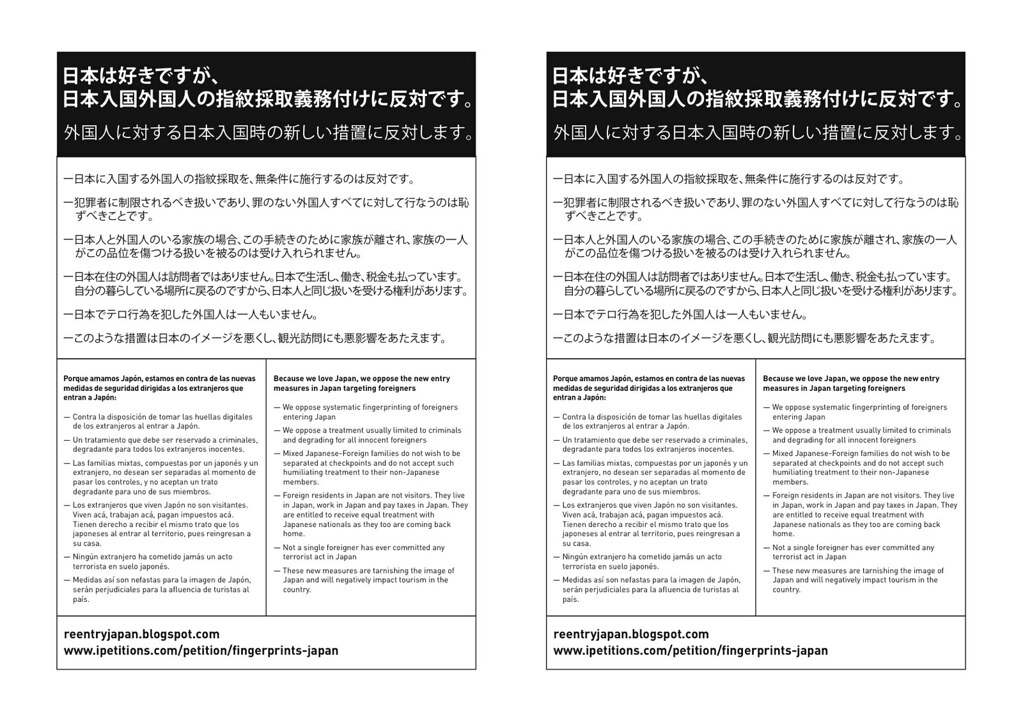
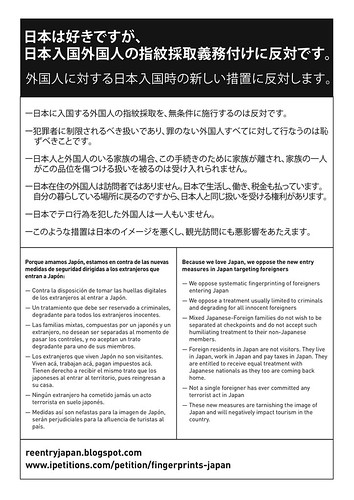
Porque amamos Japón, estamos en contra de las nuevas medidas de
seguridad dirigidas a los extranjeros que entran a Japón:
- Contra la disposición de tomar las huellas digitales de los
extranjeros al entrar a Japón.
- Un tratamiento que debe ser reservado a criminales, degradante para
todos los extranjeros inocentes.
- Las familias mixtas, compuestas por un japonés y un extranjero, no
desean ser separadas al momento de pasar los controles, y no aceptan
un trato degradante para uno de sus miembros.
- Los extranjeros que viven Japón no son visitantes. Viven acá,
trabajan acá, pagan impuestos acá. Tienen derecho a recibir el mismo
trato que los japoneses al entrar al territorio, pues reingresan a su
casa.
- Ningún extranjero ha cometido jamás un acto terrorista en suelo
japonés.
- Medidas así son nefastas para la imagen de Japón, serán
perjudiciales para la afluencia de turistas al país.
Welcome the fingerprint
What is the great injustice about asking for a lousy fingerprint? Or two, even. Or hell, why don't they just go the whole way and take all ten? That's what the Americans are doing, and they've got the whole security thing down pat. Who cares anyway? They're just smudges of sweat on a silicon sensor. Good for security, good for peace and order, good for control. It's a win-win for all. Only the terrorists lose, and who cares about them anyway.
Right?
I mean, look, it doesn't even really matter whether we want this or not. Biometrics are here to stay. Just have a look at what Nature, the world's leading scientific publication, has to say about the future of this technological marvel. Nature, aren't biometrics the coolest thing?
"Yes, because unlike conventional recognition techniques such as passwords or ID cards, which are based on 'what you know' or 'what you have', biometric recognition is based on 'who you are': anatomical features such as face, fingerprint or iris, or behavioural traits such as signature or gait. This makes biometric technologies much more difficult to abuse than traditional methods of identification. Unlike passwords or ID cards, it is extremely difficult to guess, share, misplace, copy or forge biometric identifiers."
In other words, we have gone beyond second-order identification. No more confusing ID numbers, no more quirky passwords, no more cards, no more hassle. We have truly entered an age of convenience. First-order identification means streamlined efficiency and control. No more messy intermediaries. No pseudonyms. No fake ID. No alternate identities. Our blog posts may have many tags, but we only have one, and it never changes. Our anatomical features and behavioural traits are our tag. We carry them around whether we want them or not.
And so do the terrorists.
Genius.
And you know what else is so great about this? It cost the government next to nothing. Next to nothing. Which means, thanks to the frugal spending habits and fiscal transparency of this country's fine governing system, that it cost the taxpayer -- that's you and me! -- next to nothing as well. Those Americans with their ingenious ways somehow came up with a way to extract fingerprints and photographs of an estimated 7.5 million foreigners, not to mention devise an automatic-gate system to herd us all through the process in a jiffy, for less than the cost of a personal computer. Can you believe that?
Wow. I've never felt so safe.
Can't wait to try this.
5.12.07
Apoliticism and the reign of the hypoviolent society
Apoliticism may be a factor to get obedient masses not much fuss about or even support increasing surveillance and scrutiny in daily life. What's fingerprinting in the age of FaceBook? Have you noticed how the new colored scheme information panels now being installed in JR stations come with very visible surveillance cameras? In a previously countryside like station on the western outskirts of Tokyo I know well - the name is Haijima - the station building now being refurbished into a shopping mall on top of the tracks features the automatic ticket gates with surveillance cameras on both sides, meaning that each single ticket gate is monitored two-ways by two cameras! Japan is set to shine as the world model of social hypoviolence, not hyper, but hypo it is, and not like a Los Angeles urban nightmare where steel walls arise during riots, but a Las Vegas city turned Disneyland, devoid of riot, yet clad in heavy walls still watched upon by elderly guardmen.
Some soon to be past beyond understanding idea is that such low crime society as Japan where civility, less as a moral code than a habit, still functions and crime thrives in mostly bloodless but cash rich areas, would be wise enough not to jump into the fright wagon and refrain delivering cameras in every corners. But apoliticism and wisdom do not get along well. Reading again the interview of David McNeill referred to in a post yesterday, I fancied how apoliticism as advanced as it is in Japan matches the growing equivalent trend of young masses outside Japan. It is only natural to notice in discussion forums - I am thinking of French forums especially - how biometrics screening in Japan is met by many Japan fan with a toned down if not active support of a majority. Apoliticism is a factor where East progressively meets West more than ever before. Skating on the surfaces of things, where the ice is flat, globalized and reflects the individual silhouette blurred in the mass of other skaters. The less we have to think, the more we fit together.
Scaring the tourists as a strategy?
If Germany Der Spiegel article is to be read at face value, authorities may be concerned about the potential negative effect of biometrics filtering on international tourism in Japan. If the authorities are keen enough to be concerned with mood of entrants, they will start checking that mood using surveys. And if the itch is on tourism, then lambasting Yokoso Japan! is the tactic of the day, and scaring tourists the strategy. I read somewhere the other day that Japan tourist authorities have been trying very hard to lure foreign sports team take a break in Hokkaido on their way to the China Olympics and that some UK team signed in. Unfortunately, I could not track back the news. As reported in several instances in the comment over there at the petition site, even the UK do not separate mixed families on arrival who can queue with the locals. If anyone has a reference to that UK-Japan-sport encounter, please feed me back.
4.12.07
Sophia University professor David McNeill on fingerprinting and more
"(...) just to pick the topic of the day, the whole fingerprinting issue, do you have any thoughts about this as a non-Japanese living in Japan?
DM: Well, the most sensible thing I've heard ― obviously I'm against it ― but the most sensible thing I've heard anybody say about it was a guy called William Wetherall, who writes a lot of letters to the Japan Times.
And he said that people are looking at it in the wrong way. It's not that it's discriminating against foreigners. Which it is, in the sense that it's only foreigners that they check ― which is a really bad idea, if they check people who've been here, like me, a long time, permanent residents who pay taxes, it is insulting ― but he said no, these kinds of things are always used first on the weakest part of the population, and then they are expanded.
So it's aimed at Japanese people, not at foreigners, and that's why you have to fight these things. They tend to be used initially against a group [about whom] everybody says: "oh, we have to protect ourselves from them". If you ask an average Japanese person who hasn't thought about this issue much in Japan, they'll say, oh yeah, we could fingerprint foreigners. Why not? It's only 5 minutes at the airport. And if they don't have anything to hide, then what's the problem? And anyway, there are some foreigners who are criminals, you know. People say that, right?
But those kinds of things tend to be used in that way and then expanded and used against everybody. And that's why I think Japanese people should be against this.
9-11 is used to legitimize so many bad things. Censorship and surveillance. And suspicion. It's just a very disturbing trend, and nobody knows where it's going to end."
Read the whole interview of David McNeill, professor at Sophia University in Tokyo, posted over at Gyaku. Although the fingerprinting issue comes last, the whole interview is extremely interesting.
日本語での投稿のお願い
読者の皆さん、積極な投稿のお願いです。外国人指紋採取及び国家性差別のことについて一番意識していないのは日本人でしょう。
だからこそ日本語での論文、エッセー、意見書、体験ノートなどをご投稿ください。ちなみに、ご協力は文章に限りません。漫画など、ビジュアルな投稿も大歓迎です。著作権フリーのコンテンツのみ掲載します。クリエーティブなご投稿とご支援ください。
Why foreigners only?
Emotion clouds clear thinking. Sometimes though, it boils down to try and asking the most simple question. The matter at stake here could be wrapped up like this:
Why does Japan single out and screen foreigners only?
It could also be slightly simplified like this:
Why does Japan only screen foreigners?
And even further clad in minimalist wording:
Why foreigners only? (shall we make it into a tee-shirt print for international marketability from the start? )
In the mind numbing propaganda of the authorities as November 20th was closing in, I hardly remember reading or hearing any kind of answer that would somewhat look straight in the eyes of the question : why foreigners only? then start answering: Because ... .
But fact is that the answer is readily available in daily life. Yesterday, I tested again during a break a theory of mine that middle class mind Japanese is still strong, nay, endemic, world class as a matter of fact, and probably forever. I invite you to do the same and report back here. We had plenty of time to chew the fat on banalities with my clients, one of whom being Japanese, +20 years in a large foreign company, engineer, read, posed, learned, travelled in many places in the world, speaking English fairly well, etc. The conversation about life in Tokyo slipped to street safety with my American client chatting about walking alone at night in New York and feeling scared all of a sudden because aware to be absolutely alone. His Japanese counterpart launched the standard "crimes in Japan are on the rise" mantra, me flashing back that statistics are telling a different story, him placidly delivering the other standard story about organized groups of Chinese and Koreans, me lashing back by asking whether he ever had any experience of crime of any kind, him telling no, me asking whether he knew about family members or close friends having met with crime, him telling no. End of the interrogation. Someone stole my Bridgestone bike some 10 years ago. Almost brand new it was.
What is the number of crimes perpetrated by non-Japanese as a percentage of all crimes listed in a year in Japan? I have never seen a clear answer to that seemingly simple question. Simple questions that do not tread on metaphysics, moral or religious ground should easily come with simple answers, unless they generate in the mind of the questioned a massive attack of sudden mind-chilling numbness.
Your mission - if you accept it - will be from now on to ask around the single and simple question : "Why foreigners only?". Be warned however that you may end up loosing friends, feel the chill of silence and disapproving glances, to end up not being invited ever again next time.
And if you wish to seriously write, report and pounder on related issues in Re-Entry Japan as a collaborative writer, please raise you hand.
3.12.07
Think local, act local
In the rethorics of meek followers of the status quo with what authorities do here or there, is the redundant argument that Japan :
- is not the first to implement biometrics screening
- is not the last
This "there is a precedent" that sounds unlike the traditional local "there's no precedent" surprisingly yields similar results: do nothing, go with the flow.
But the argument doesn't stop here. Browsing through some Japan forums of the West, I am flabbergasted at the recurrent counter attack toward critics of the Japanese biometrics measures. The standard script reads like this : why are you not protesting against what the USA, the UK and where else are already doing at the gates?
The answer to this is simple: know global, think local and act local. Local activism may set a "precedent" that will turn more efficient than a worldwide campaign. Not that a worldwide campaign is out of question, but the timing is bad. Japan - if not alone in the case - is in dear need of an ethical cure. I am acting locally as other people around to deliver.
We expect some echoes about Re-Entry Japan and the protest tract in the local media hopefully soon. As reported in Debito.org, at least one local celebrity, Peter Barakan, may expand about the ostracism of this fingerprinting happening here in Yokoso Japan over the NHK airwaves. At a time where most local newspapers - with a few exceptions - have shut the iron curtain on the subject, or moved to the "they are now fingerprinting not two but ten fingers in the US! (more than us Japan)", it is heart warming to see the surface still bubbling. Anyone German language ace to translate the tract text? Chinese and Korean versions will look good as well.
2.12.07
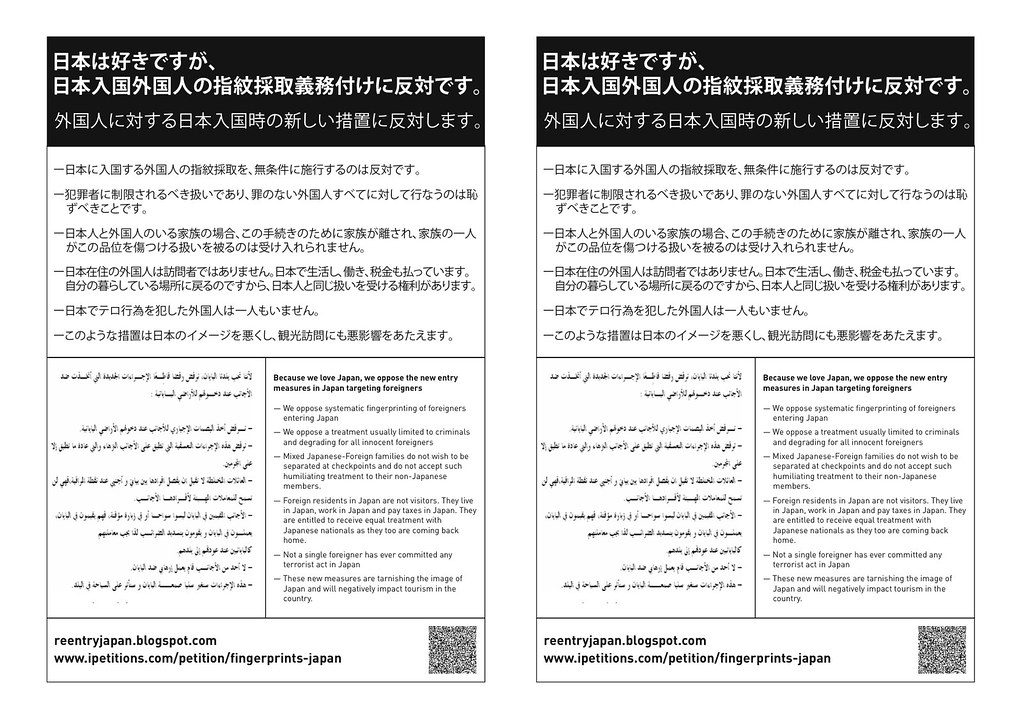
Revised and new version of the Tract now in Arabic

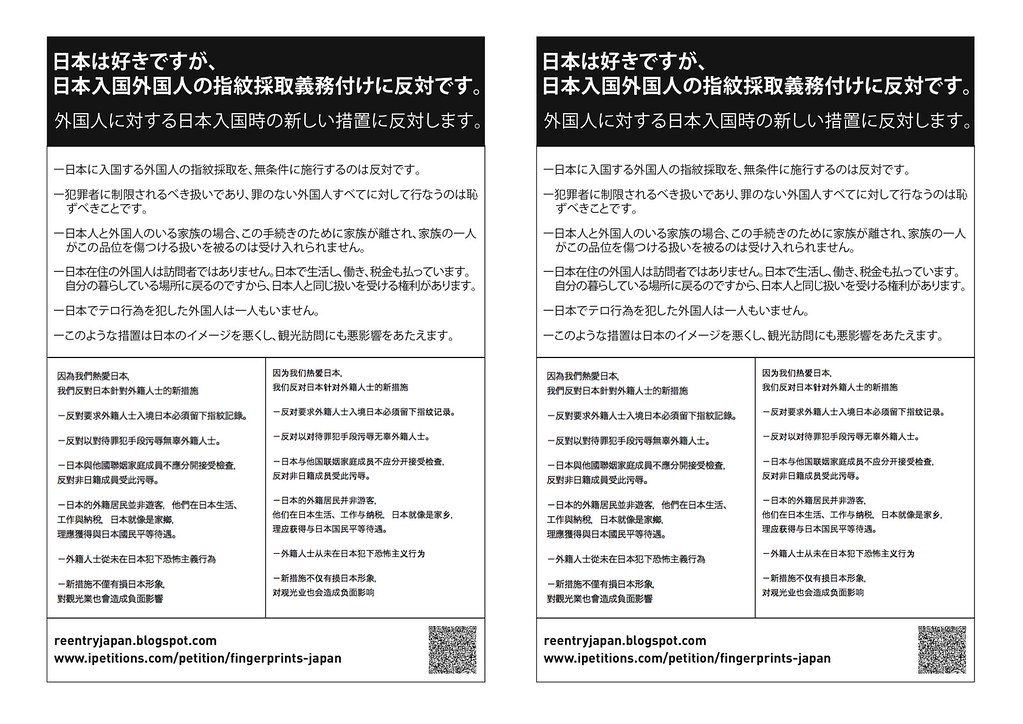
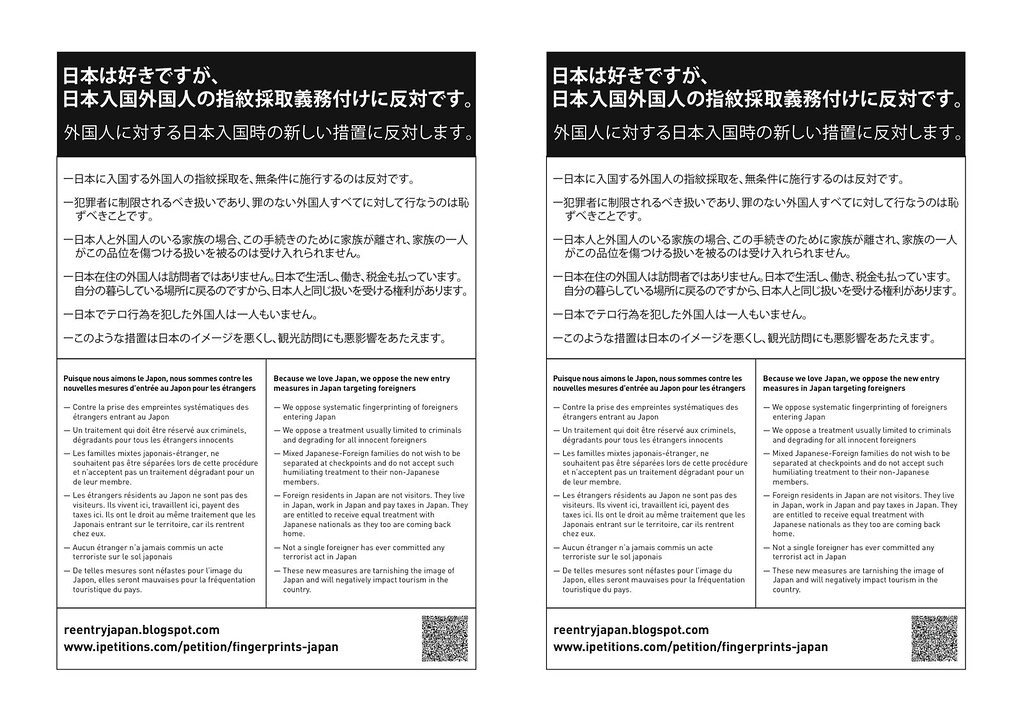
Thanks to the collaborative spirit of this blog, we have a revised version of the tract, and a new one with Arabic text.
Download from the links of the upper right column of this page.
As usual, if you detect any typo, please send a comment and help make it better.
Once again, the usage of this tract is yours. We advise clean, responsible attitude and behavior with using it. Do not litter, do not distribute in the street as prior authorization is required in Japan. Be creative in safe ways. And report your experience.
Protest sheet version 1.1.1 + arabic version

Thanks to reader's help, a new version is done with an arabic part.
And two spelling mistakes have been corrected.
Links to download are located on the upper right corner of this screen.
1.12.07
Queuing
The Atlantic Monthly reporter James Fallows has a short article about his arrival at Tokyo airport, mentioning that "Today's time spent in the passport clearance line for foreigners at Narita: 1 hour, 30 minutes.". He is smart enough not to simply focus on the inconvenience of the procedure, and states that "there is no getting around the insult factor of having entry to the country be like getting booked into County Jail". I can hardly imagine queuing 1.5 hours at passport clearance. 1.5 hours including waiting time for luggage that do not appear, yes. But for passport checking, this goes beyond everything. How many planes are landing in the meantime with several hundreds passengers flocking to the crowded gates. How do people in the queues react? No grumbling at all? no noisy sounds of exasperation? Or was it that Mr. Fallows was unfortunate to bump into a worst day at the gates? So many questions, so few echos from the lines.